Sunday, October 15, 2023

Simple techniques yield big impact with texture and color

Don’t ya love projects that make a statement but are easy to make? These small projects use basic techniques, require minimal tools and supplies, and still make an impact because of their colors and textures.

Woven coaster and hand knit cotton dishcloths are easy projects.

Loopy Loom woven coasters

Tools and Materials: Loopy Loom, worn out socks, scissors, crochet hook

On occasion, I love to pull out my red Loopy Loom and weave a coaster or a pot holder from worn out or orphan socks. My metal Loopy Loom came with a long metal hook for weaving, but I use my fingers for the tabby (plain weave: over 1, under 1) weaving technique. Stripes and other patterns on socks add color and interest to the woven texture. 

Use the Zoom Loom and a pair of worn out socks.

I use a crochet hook to finish the looped edges after the weaving is complete. We use these small weavings for coasters (hot and cold beverages), hot pads/trivets, and pot holders. This is a wonderful re-purposing project and great way to upcycle unrepairable socks.

Hand knit dish cloths

Tools and Materials: cotton yarn (variegated, solid, or both), knitting needles, crochet hook, yarn needle for weaving in the yarn tails.

Hand knit cotton dishcloths.

Using a linen stitch pattern, the slip stitch knitting technique creates a firm fabric and an interesting texture on these hand knit dish cloths. With a variegated yarn, there is an additional lovely color interchange created by the slipped stitches from the row below. This is the perfect stash-buster yarn project! Use up those extra little balls of yarn for a fun and useful project. 

A crocheted edge in single crochet or a slip stitch unifies the piece and finishes the edges. A yarn needle is helpful to weave in the yarn tails. 

Hand embroidery on printed fabric

Tools and Materials: embroidery floss, embroidery needle, embroidery hoop (optional), scissors, a fabric print

Basic embroidery stitches: back stitch, stem stitch, French knots, pistil stitch (long French knot), running stitch, straight stitch, blanket stitch.

Hand embroidery on a printed fabric panel.

Using fabric prints and fabric panels is NOT cheating. Capitalize on and enhance the printed motifs on fabrics. 

This is a cotton fabric panel from an upcoming holiday collection from FIGO Fabrics. Using 2 or 3 strands of embroidery floss, I’m embroidering around motifs and on the outlines. Any basic embroidery stitches will create beautiful textures. An embroidery stitch dictionary also has loads of inspiration for experimenting with new stitches. 

Hand embroidery on a printed fabric panel.

Choose floss in holiday colors, neutrals, brights, or colors from nature. Embroidery floss is inexpensive and readily available in a multitude of glorious colors. Or experiment with other beautiful threads such as perle cotton (various weights), cotton sashiko thread, and novelty yarns and threads. Got a thread stash? This is the perfect small canvas to use savored lengths and leftovers from other projects.

Hand embroidery on printed fabric panel.

These embroidered pieces can be backed and stuffed with a polyfill. A ribbon or yarn loop can be added to create holiday ornaments or gift decorations. Or they can be displayed as home decor in a festive bowl or basket.

Make small projects with big impact and happy stitching!


Saturday, October 7, 2023

Cold Front = long sleeves or jackets?

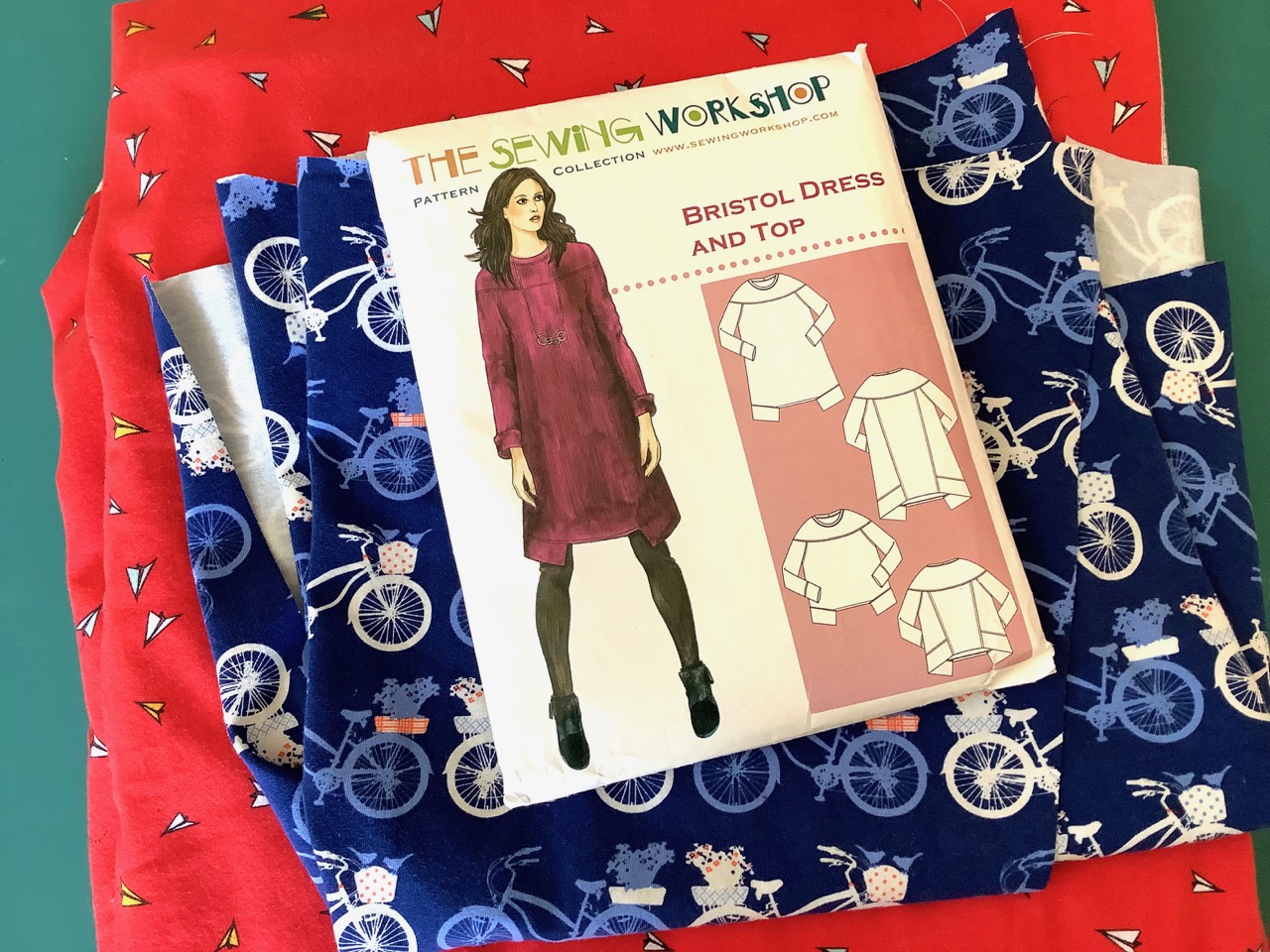
We awoke to mid 50-degree temperatures this morning. The cold front came through overnight and the upcoming week is predicted to be in the mid-60s to mid-70s. Although I welcome the crisp, cooler Fall weather, I have two short sleeve Bristol knit tops cut out and ready to sew!

Bristol Top with short sleeve version cut out.

Short sleeve pattern hack

I've made the Bristol Top several times. It looks different with every fabric print and it's fun to mix and match fabrics for color blocking. The pattern pieces lend themselves to several fabric combinations—yoke, sleeves, cuffs, bottom flap. 

On a re-make in 2022, I did a pattern hack—to make a short sleeve version. This weekend, I wanted to fine tune the sleeve by shorting the length and making the opening slightly larger to allow for more movement.

Short sleeves cut out and ready to sew.

The original sewing plan

I got an itch to do some garment sewing last month. My original plan for a new Bristol was:

  • to use up knit fabric remnants from my stash,
  • add to my short sleeve knit top wardrobe (I have mostly long sleeve knit tops),
  • fine tune the short sleeve pattern piece from the previous pattern hack.

The sleeve pattern was modified. I had all the pieces cut out for two short sleeve versions... ready to sew. 

         Now the darned cold front has moved through...

Another fabric combination for a new Bristol Top.

Throwing caution to the wind, I say, "Too bad on the weather forecast!" I'm sticking with the original plan and will take a jacket along. 

Plus, you can't always trust the weather forecast, now can you???


Sunday, September 24, 2023

The One-Day Wiksten top

Last weekend was my birthday. I decided to forego paperwork and blogging to enjoy the pleasant September weather, go out to lunch at a favorite downtown trattoria, and do some “me-sewing.” The result was a new, one-day Wiksten top.

Wiksten top made with yarn dyed wovens [Diamond Textiles] and scrappy triangles.

Wearing my new Wiksten top.

Reusing a pattern

I’ve used the Wiksten pattern two or three times before, so the pattern pieces were already modified and fitted to me. For this new version, I made two other changes to my existing (modified) pattern pieces: lowering the front neckline slightly so it would more easily slip over my head, and adding an inch to the length.

Lengthened bodice pattern piece.

Fabrics and pattern hacks

I had some light colored yarn dyed wovens [by Diamond Textiles] that were already pre-washed and suited for a casual summer top. I mixed two dobby wovens that had inherent texture and I believe I used the “wrong” side of the check fabric because I thought it was more interesting. That is one of the beauties of yarn dyed wovens—you can choose the “right side” or the “other right side” of the fabric for your project.

A handful of  HSTs [half square triangles] were picked from my scrap box and strip pieced. This patchwork strip was inserted into the bodice front—to add a bit of color.

Patchwork insert on the bodice front.

Vents were put in at the side seams—an easy detail to add to this top. The neck facing was cut from a cotton print which made this a fun, scrappy make. The sleeves were hemmed by hand. The 3/4” bottom hem was sewn by machine. The hem stitches are camouflaged by the woven fabric.

Wiksten top flat view.

The Wiksten is a fast make. Even with my modifications, I finished this version in a day. The original pattern has options for a shift dress, a longer 3/4 sleeve, a gathered back version with a yoke, and pockets. It’s a good base pattern for hacks. It has a boxy, casual look but I read a hack where someone has added darts. 

Another Wiksten has been added to my wardrobe! One day under the needle… and the next day ready to wear.

On the deck outside my studio wearing my one-day Wiksten.


Sunday, September 10, 2023

Saeksilnubi: the craft of traditional Korean quilting

This weekend, I treated myself to a virtual class on Saeksilnubi, Korean quilting. The class instructor was the delightful textile artist, Youngmin Lee, who introduced students to this traditional craft. Here is the progress of my class project after the two-hour workshop.

Beginning the saeksilnubi technique on a 7" square of linen fabric.

Saeksilnubi, a traditional Korean craft, uses two pieces of fabric that sandwich a hanji cording made from twisted and rolled strips of mulberry paper. Colorful threads are used to hand stitch the channels that hold the paper cording in place. It is similar to the “stuffed” look of trapunto and bouti, but the process is slightly different.

A beautifully and thoughtfully packaged kit accompanied the class.

Class kit for Saeksilnubi.

With a little pre-work rolling the hanji paper cords, students had all the materials to hit the ground running when the online class began.

Saeksilnubi kit contents.

Saeksilnubi is a slow stitching process that should be savored and not rushed. Although it is a craft for items with utilitarian purposes, the focus is on the making—the stitching process—not the urgent haste to finish. Youngmin encouraged her students to instill good thoughts and happiness into every stitch.

Youngmin Lee, textile artist and instructor.
This virtual workshop was hosted by Tatter.

This quilting technique requires minimal tools and materials… and is very portable. I look forward to the hand stitching process and being part of keeping this Korean handcraft tradition alive. 


Related Posts Plugin for WordPress, Blogger...