Showing posts with label weaving. Show all posts

Saturday, December 2, 2023

Loopy Loom weaving with Bombas socks

I’ve been enjoying doing upcycled and scrap busting projects lately. They’re stress free… mindful… textural… and it keeps textile items out of the trash and landfill.

Woven rug mugs from upcycled socks.

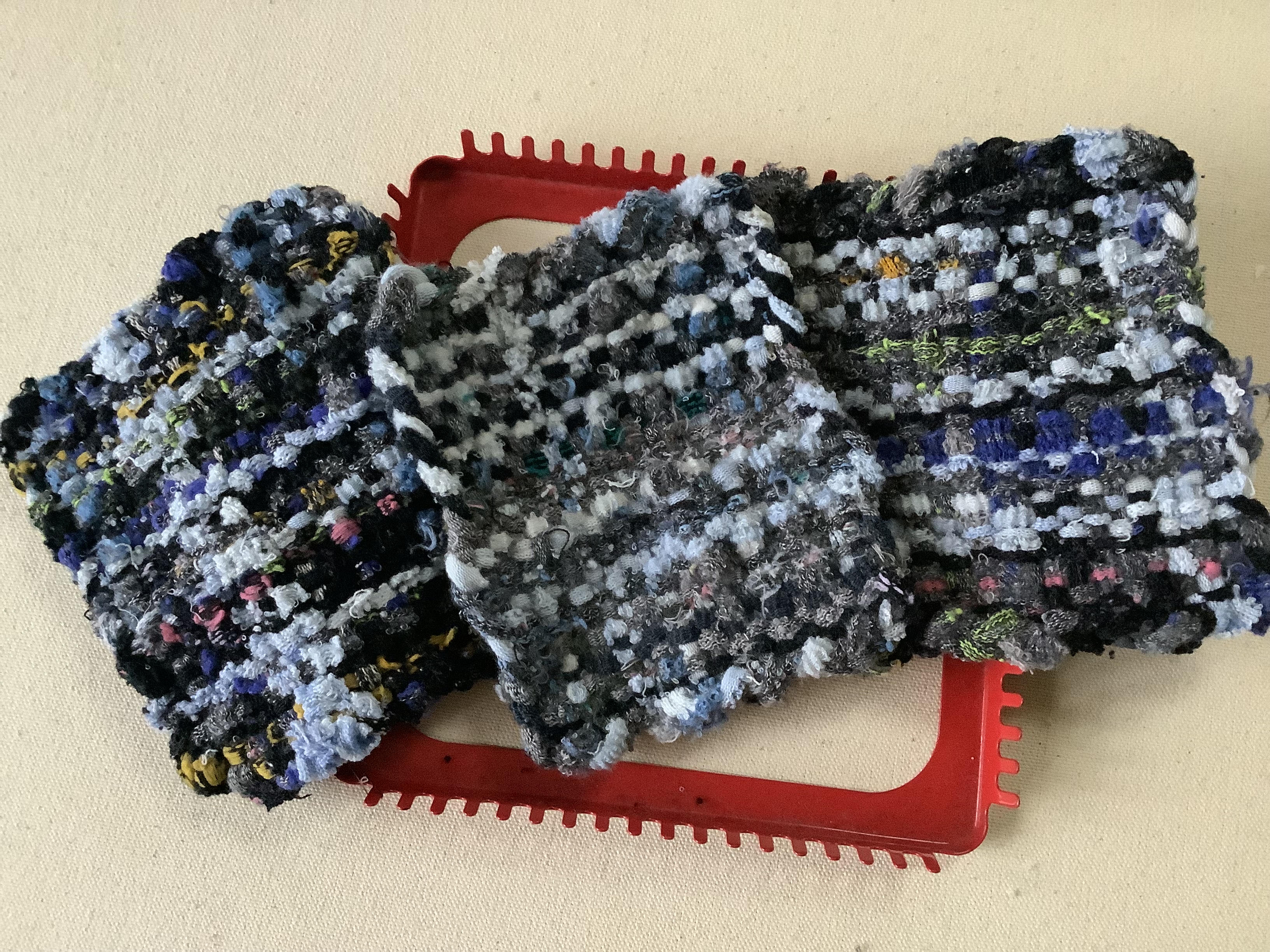
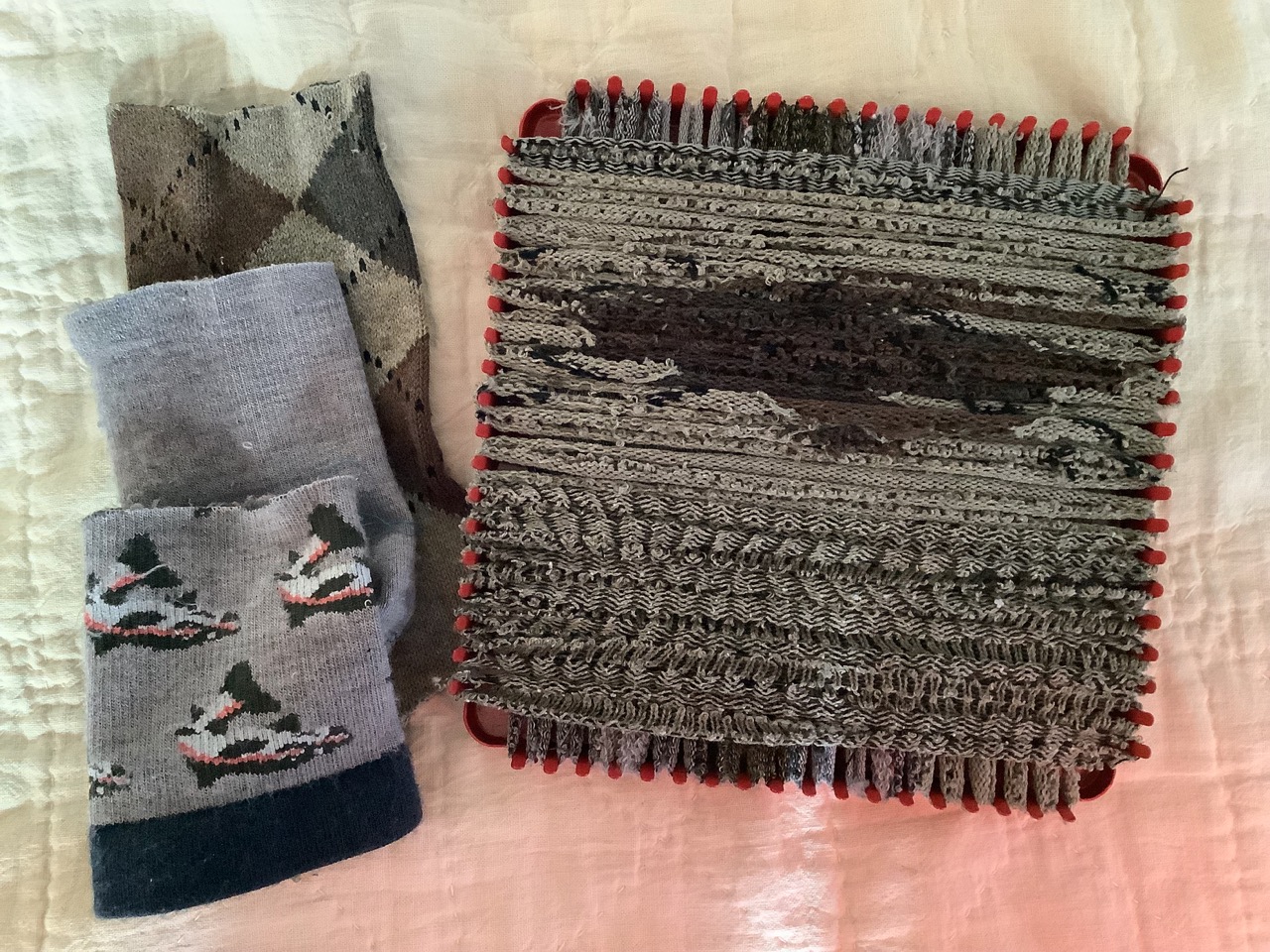
As long-lasting and hard-wearing our Bombas socks are, eventually the heels develop thin areas or holes. This weekend, I pulled out the Loopy Loom and a bag of un-mendable socks and started to weave with sock loops. A pair of light colored tie-dyed socks were incorporated with some of the darker colors. 

Weaving with light and dark color values on the Loopy Loom.

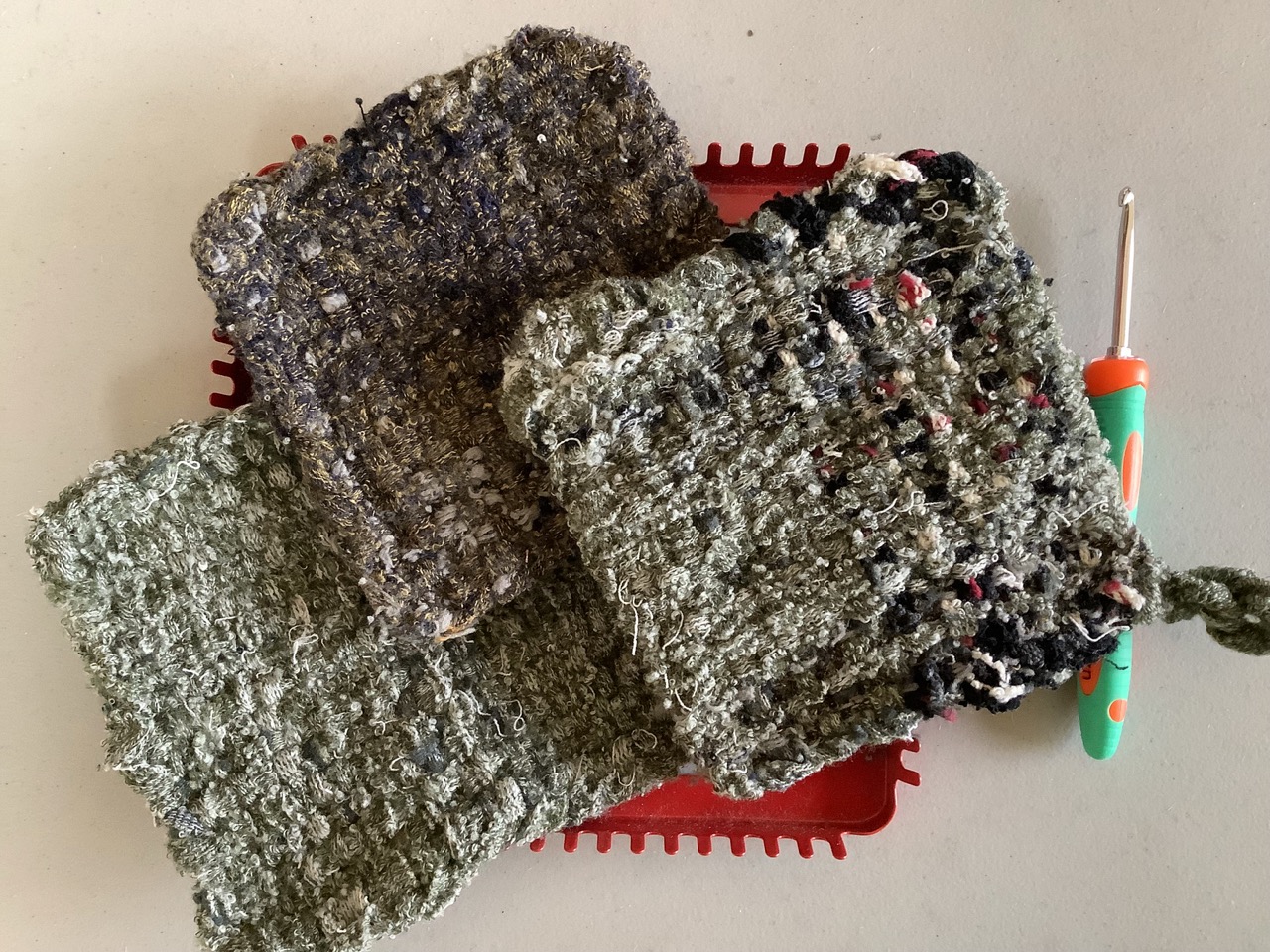
Because these socks have areas where the knitting has tighter elasticity, the weavings don’t come off the loom completely square. However, I think the organic shapes are interesting and fun (and a bit funny-looking). But they are thick and dense and make great hot pads and mug rugs. This batch is slightly more decorative because of the color combinations.

Three woven mug rugs off the loom.

So, cheers to the upcoming season of colder days, hot chocolate, hot tea with honey, and using a new set of upcycled mug rugs!


Sunday, October 15, 2023

Simple techniques yield big impact with texture and color

Don’t ya love projects that make a statement but are easy to make? These small projects use basic techniques, require minimal tools and supplies, and still make an impact because of their colors and textures.

Woven coaster and hand knit cotton dishcloths are easy projects.

Loopy Loom woven coasters

Tools and Materials: Loopy Loom, worn out socks, scissors, crochet hook

On occasion, I love to pull out my red Loopy Loom and weave a coaster or a pot holder from worn out or orphan socks. My metal Loopy Loom came with a long metal hook for weaving, but I use my fingers for the tabby (plain weave: over 1, under 1) weaving technique. Stripes and other patterns on socks add color and interest to the woven texture. 

Use the Zoom Loom and a pair of worn out socks.

I use a crochet hook to finish the looped edges after the weaving is complete. We use these small weavings for coasters (hot and cold beverages), hot pads/trivets, and pot holders. This is a wonderful re-purposing project and great way to upcycle unrepairable socks.

Hand knit dish cloths

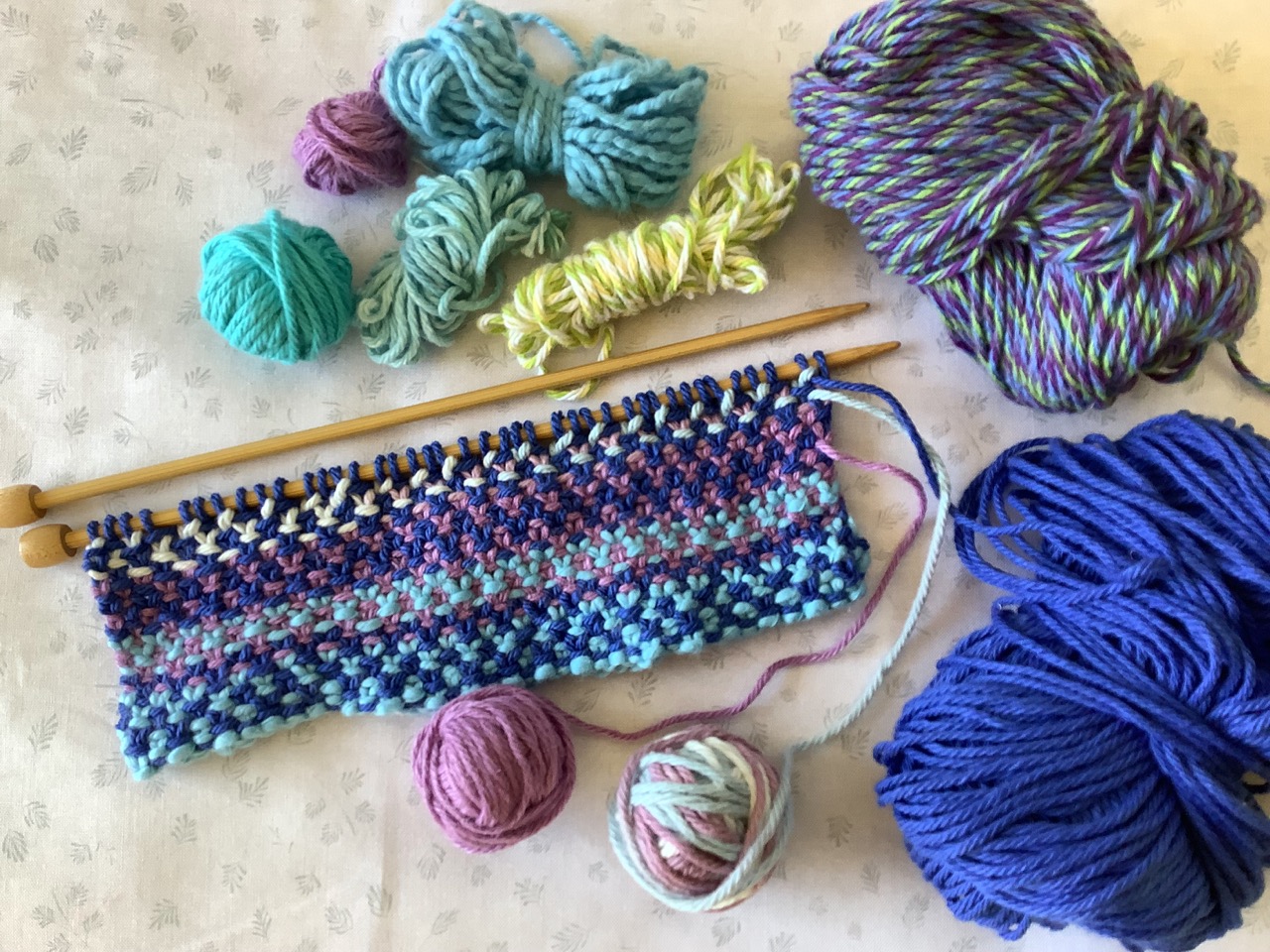
Tools and Materials: cotton yarn (variegated, solid, or both), knitting needles, crochet hook, yarn needle for weaving in the yarn tails.

Hand knit cotton dishcloths.

Using a linen stitch pattern, the slip stitch knitting technique creates a firm fabric and an interesting texture on these hand knit dish cloths. With a variegated yarn, there is an additional lovely color interchange created by the slipped stitches from the row below. This is the perfect stash-buster yarn project! Use up those extra little balls of yarn for a fun and useful project. 

A crocheted edge in single crochet or a slip stitch unifies the piece and finishes the edges. A yarn needle is helpful to weave in the yarn tails. 

Hand embroidery on printed fabric

Tools and Materials: embroidery floss, embroidery needle, embroidery hoop (optional), scissors, a fabric print

Basic embroidery stitches: back stitch, stem stitch, French knots, pistil stitch (long French knot), running stitch, straight stitch, blanket stitch.

Hand embroidery on a printed fabric panel.

Using fabric prints and fabric panels is NOT cheating. Capitalize on and enhance the printed motifs on fabrics. 

This is a cotton fabric panel from an upcoming holiday collection from FIGO Fabrics. Using 2 or 3 strands of embroidery floss, I’m embroidering around motifs and on the outlines. Any basic embroidery stitches will create beautiful textures. An embroidery stitch dictionary also has loads of inspiration for experimenting with new stitches. 

Hand embroidery on a printed fabric panel.

Choose floss in holiday colors, neutrals, brights, or colors from nature. Embroidery floss is inexpensive and readily available in a multitude of glorious colors. Or experiment with other beautiful threads such as perle cotton (various weights), cotton sashiko thread, and novelty yarns and threads. Got a thread stash? This is the perfect small canvas to use savored lengths and leftovers from other projects.
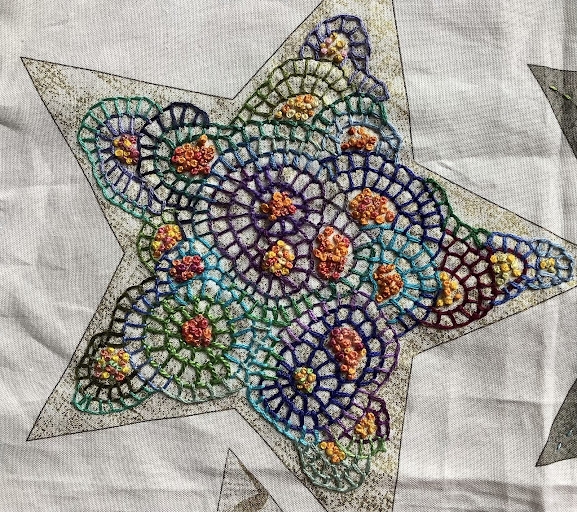
Hand embroidery on printed fabric panel.

These embroidered pieces can be backed and stuffed with a polyfill. A ribbon or yarn loop can be added to create holiday ornaments or gift decorations. Or they can be displayed as home decor in a festive bowl or basket.

Make small projects with big impact and happy stitching!


Sunday, December 18, 2022

Minimize textile waste with upcycled, scrap buster projects

I try my best to minimize fabric, yarn and clothing waste through scrap projects, mending and donating to charities. Looking around the house and my studio lately, I realized the variety of scrap buster projects—for both yarn and fabric scraps—that I worked on in 2022. These are favorites from this past year.

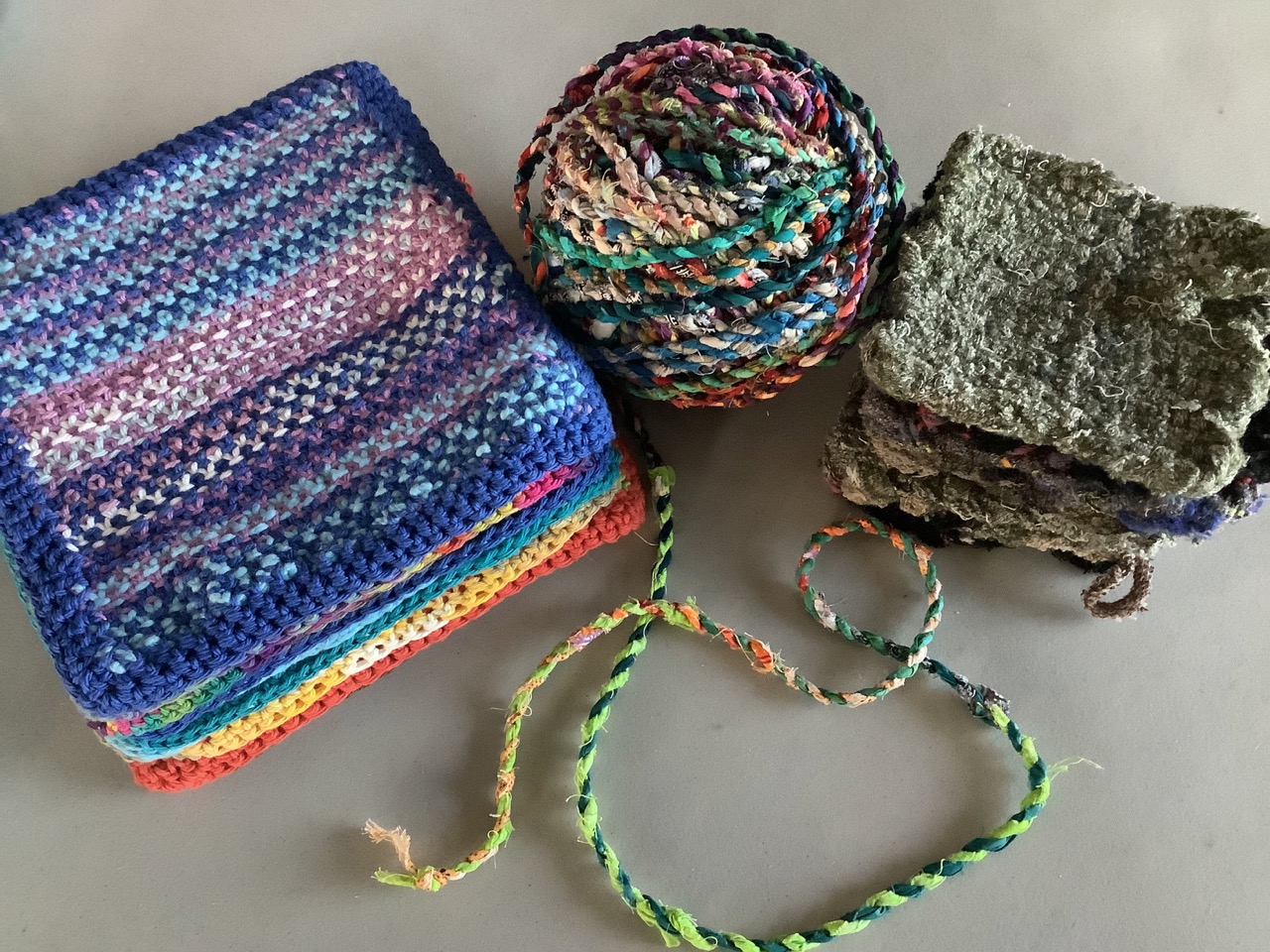
2022 upcycled and scrap buster projects: (from left) knitted dish cloths, fabric twine,
and Zoom Loom sock mug rugs.

Hand knit dishcloths

After discovering the Dishcloth Challenge from Modern Daily Knitting this summer, I got immersed in these scrap-busting, quick knits. Dishcloths are also a great portable project for travel. 

Cotton dishcloths use up multitude of leftover yarn scraps.

Combining small bits of leftover yarns, I enjoy the experimental practice of unplanned color combinations and the surprising results. I have mostly used the linen stitch because it's easy to remember, and the slipped stitches merge the yarn colors within a single row.

Fifteen colorful cotton dishcloths.

Cotton dishcloths qualified for my Slow Stitching Make Nine project in August, but I have continued making them through December. I like that these are colorful and pretty as well as functional.

Dishcloths: Slow Stitch Make Nine Project.

The last one is off the needles with just the crochet edge remaining.

Dishcloth ready for crocheted edge finish.

Fabric twine

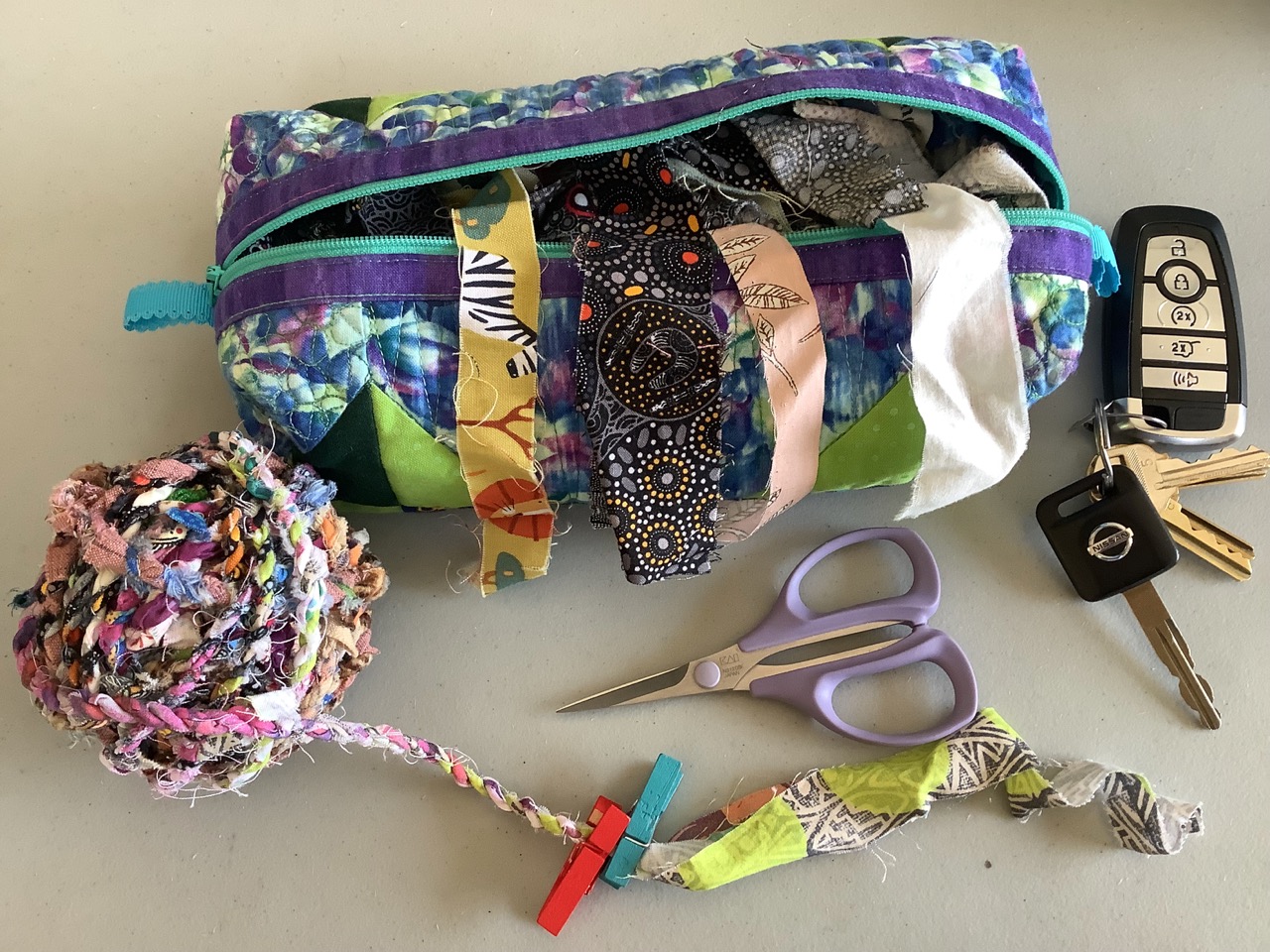
In 2021, I started making fabric twine with trimmings and strips from quiltmaking. Any fabric strip that is too thin to use for patchwork—especially if it's a long strip—is set aside for making twine. I've continued making twine this year. It's another good travel project.

Taking fabric twine supplies when traveling.

The Loopy Loom upcycles socks into coasters

A rediscovery of the Loopy Loom/Zoom Loom is converting old socks into woven coasters. 

Using the Loopy Loom for sock weaving.

I'm still experimenting with these as I've learned that some socks contain elastic and the loops stretch and contract at different rates. So, sometimes the coasters are slightly off-square.

Woven mug rugs from discarded socks.

But this project ticks all the sustainability boxes for me! It takes an un-repairable textile and converts it into a new, useful object. And these little coasters are thick and squishy and so very functional. They fulfilled my Mend/Upcycle prompt for Make Nine 2022.

Collection of woven sock coasters/mug rugs.

Improv patchwork kitty quilts

Of course, a wonderful scrap project is making kitty quilts and charity quilts. In 2022, sixteen kitty quilts were made and gifted to friends, the Cat Clinic of Chattanooga, or are enjoyed by our pack of adopted outside kitties. (Note, our kitties adopted us, not the other way around.)

Improv patchwork quilt top ready for quilting.

The kitty quilts fulfilled the Scraps and Crumbs prompt for Make Nine 2022. Not only are fabric scraps used to make these, but odd strips and pieces of batting are also patched together to make these quilts.

Four improv patchwork kitty quilts.

Twelve scrappy kitty quilts.

Scrap buster 2022 year-end tally

  • 19 cotton dishcloths
  • 8 recycled sock mug rugs made on the Loopy Loom
  • 16 kitty quilts
  • 4 cuddle quilts for the guild's community service project
  • yards and yards of fabric twine

A fulfilling year!


Sunday, July 10, 2022

Upcycle your argyles with a loom! Make Nine finish #5

If the socks in the laundry basket are really too far gone to mend, here's a fun idea to remake them into something useful. 

Ready? Get out the scissors! 

The worn sock remake.

Cut the socks into tubes...

Socks cut into tubes.

and weave them.

Weaving with a mini loom and sock tubes. 


The potholder loom keeps worn socks out of the landfill

Remember those rainbow-colored fabric loops and the mini weaving loom you had as a kid? They still make them! I have a shiny new red metal one. And now I'm cutting up worn-out socks to make the loops for the warp and weft. 

Those worn socks get a new life as a mug rug or hot pat and avoid the fate of ending up in a landfill. It's a great repurposing project, earth friendly, and quick and fun to do as well.

Three woven hot pads, metal weaving loom, and crochet hook for binding off.


The weaving process and design options

The weaving set-up and process is the same as when you were 7 years old. If you don't remember, there are instructions/illustrations online or that come with the loom.

My sock tubes were cut about 3/8" wide and it took most of two adult size, short, ankle socks to yield enough loops for my 7" square loom. If you're cutting up knee socks, there will be plenty of loops for one woven square and enough to start the next.

Cutting socks into tubes. The argyle will provide a contrasting color.

If your socks are various colors or prints, try blending them to create stripes and plaids. You'll see a change in color but the pattern of the old sock—like the argyle pattern—becomes obscure through the weaving process.

The weaving process on the mini loom. 

The loom is portable. I can weave on a table or in my lap. I accomplished the "bind off" with a crochet hook.

Binding off with a crochet hook.

The finished hot pad is between 5" - 5.5" square once it's been released from the tension of the loom. You can see the difference in size between the 7" loom and the finished piece.

The finished woven hot pad is approximately 5" square.

The loom came with a metal hook for weaving, but I found weaving with my fingers worked really well. 

I haven't tried it, but the woven squares could probably be stitched or crocheted together to make a larger piece if one desired. For now, I'm using the pieces straight off the loom as hot pads and mug rugs.

Three woven hot pads/mug rugs made from worn out socks.


My 5th Make Nine finish for 2022

Although I have mended quite a few projects this year—shirt collars, shirt sleeves at the elbows, T-shirt hemlines and necklines, toes of socks, the buttonhole on a pair of jeans—I'm going to count this old-sock re-make as fulfilling my "Mend/upcycle" prompt for Make Nine 2022. It's a blast from the past and still as much fun now as it was as a kid.

Make Nine 2022 worksheet, July 2022.

I hope you find the "joy of making" as exciting now as when you were a kid!


Sunday, January 20, 2013

My talented friends, Forkner and Clabo

I had the opportunity to catch the opening reception of Alternate Realities, an art exhibit sponsored by the Knoxville Arts and Culture Alliance at the Emporium Center in Knoxville, Tennessee. My friend Geri Forkner, a talented mixed media weaving and felting artist, had several of her pieces on display in the show beside work by artists Elizabeth Porter and Carl Gombert.
Daily Weaving is a free-hanging woven structure comprised of small, daily weavings
made from found and discarded materials. This piece reflects 2 years of weavings.
Electronic components are incorporated throughout the piece.
See other photos (photographed in the daytime) here.
For the past few years, Geri has been studying and experimenting with electronic components and how to incorporate this technology into her weavings, wearables and felting art. The large installation above, Daily Weaving, incorporates battery powered lights within the free-hanging woven pieces. Below, Geri  is wearing a woven vest made from recycled papers and salvaged packaging materials. Her felted floral broach incorporates conductive thread and fiber optics. She is standing beside a weaving created from recycled coffee bags. The coffee packaging material offers a subtle reflectance that gives richness to the browns and copper tones.
Mixed media weaving artist, Geri Forkner.
I was also inspired by the Radiant Geometries exhibit of Carl Gombert's pen and ink and hand-stamped ink work. I found some potential fodder for my free-motion quilting experiments in his pen and ink drawings. Both exhibits go through January 25, 2013. Check them out, if you are in the Knoxville area. The Emporium is a great space with large upper and lower galleries.
The Emporium Center, 100 S. Gay Street, Knoxville, TN
Another very talented friend of mine is machine quilter extraordinaire, Margo Clabo. I saw this quilt during a recent visit to Chattanooga Quilts quilt shop. It is a sample piece promoting a Borders class that was team taught by shop owner, Kim Thomas, and quilting instructors Mellissa, Karen and my friend Margo. 
Medallion quilt at Chattanooga Quilts, Ooltewah, TN.
This beautiful medallion quilt employs a lovely red/green color scheme (who doesn't like this classic color combo?). It's spinkled with whites that add a freshness and sparkle and is complemented with a buttery yellow outside border. But what stopped me in my tracks... was the quilting. In true Margo style, the attention to detail was exemplary. I knew immediately (almost without having to ask) it was Margo's work.
Close up of the machine quilting.
What I love about Margo's quilting is that she steps beyond the pieced block and superimposes another layer of pattern and design with the quilting. She changes a sawtooth border into a chain of squares on point. Large squares are transformed into 4-patches, and two parallel half round channels (almost trapunto-esque conduits), travel around the center medallion to emphasize the geometry of this symmetrical layout.
Corner detail of the machine quilting.
The pseudo-Baptist Fan swashes on the wide outside border creates movement and dimension. Upon closer inspection, you can see featherlike flourishes superimposed over half-square triangle patchwork. Margo performs her magic using a long arm quilting machine, but her quilting design sense is inspiring to anyone—whether you use a sit-down, domestic or long-arm machine.

It's a honor to have friends with such talent. Gee, if they continue to let me hang around them, maybe some of their artistic flair will rub off. Ya think?

Friday, April 16, 2010

Go Green with Fiber Arts

On Thursday, April 22, I'll be with fellow members of the Riverbend Fiber Arts Guild to celebrate Earth Day 2010 at the Memorial Hospital Earth Day Celebration. We'll be giving demonstrations on spinning, weaving and free-motion machine quilting from 11 am. to 1 pm. in the community rooms at Memorial Hospital's main campus, 2525 de Sales Avenue, Chattanooga, TN.
Other companies, organizations and hospital employees will also be showcasing ecological, recycling and environmentally-friendly items and projects at the celebration. The event is open to the public. Go green with Fiber Arts!

Wednesday, October 21, 2009

Inkle Loom Weaving workshop

This past weekend, the Riverbend Fiber Arts Guild members demonstrated spinning and weaving at the Ketner's Mill Fair, an annual country craft and art fair in Whitwell, Tennessee. One of the weaving techniques demonstrated was Inkle Loom weaving, and I got to talk with weaver extraordinaire, Mary Lou Scohier, for a step-by-step view of dressing and weaving on this type of loom.

The Inkle Loom is a classic loom for beginners because of its simplicity and ease of use. The tabletop loom Mary Lou used for the demo was small, compact and very portable but she indicated Inkle looms come in various sizes. She has a larger, floor loom at home. Inkle weaving dates back thousands of years and was introduced in the United States in the 1930s. The narrow format of Inkle weaving lends itself to such things as belts, bands, straps, trims, ribbons, garment decorations and accessories. Creativity abounds with the use of color and pattern. 

Worsted weight yarn was used for the warp and weft threads on Mary Lou's piece, but any weight of thread, yarn or string could be used. As an art quilter who creates wearables, this opened up my mind to all kinds of possibilities!

If this technique piques your creative curiosity, the Riverbend Fiber Arts Guild is hosting an Inkle Loom workshop November 14-15. The instructor, Ann Mullican, is a well-known weaver and teacher in the weaving community. Workshop participants (I'll be one of them!) will learn the weaving technique by making a "Woven Doll with Character." Details for the workshop are on the guild's web site. Come and join the guild for a fun weekend of Inkle weaving.


Create your own Inkle Loom Doll with Character!
Related Posts Plugin for WordPress, Blogger...