Showing posts with label Loopy Loom. Show all posts

Sunday, February 11, 2024

Mending a burn hole in the red dish towel

The Winter of Care and Repair Challenge started on December 21 with the Winter Solstice. My latest mend for this Challenge was on a dish towel that “got too close” to one of the burners on the stove. (No fire, but it left a sizeable hole in the towel.)

My Winter of Care and Repair, December 21 2023 - March 19, 2024.


Goals for my Winter of Care and Repair

The parameters I set for myself in the Winter of Care and Repair Challenge focus on textiles:

  • mending and repairing
  • upcycling/repurposing
  • organizing my fabric and yarn stash (not making much progress with this goal)
  • finding ways to minimize scraps.

As part of my commitment to this 3-month Challenge, I was determined to mend the burn hole in the red dish towel. I decided to use a patch rather than try a weaving mend.

A burned hole in the dish towel.

The repair process

After brushing off the singed part, I traced the shape of the hole on a piece of paper. 

The hole was almost 1.5”.

I decided to use knit fabric for the patch instead of a woven so I didn’t have to turn under the edges.

Making a paper template for the patch.

The patch was cut about an inch larger (all around) than the paper template (the size of the hole). The patch was pinned to the right side with another fabric scrap placed on the under side to conceal (sandwich) the hole. Five additional circle patches were added to the towel to make the appliqué circles look “intentional”—like a “design element”—rather than a single patch over a hole.

Pinning various circle patches to embellish (and repair) the towel.

Using matching cotton embroidery floss, the patches were secured with a running stitch—starting on the outside of the circle and moving toward the center in a circular design. After stitching, the patches were trimmed closer to the stitching line.

Running stitches secured the circles to the towel.

The matching red embroidery floss blended with the fabrics. The stitching added a textured pattern to the appliquéd circles.

Appliquéd circles embellish the repaired dish towel.

My red dishtowel is now back in circulation! It’s shown here with three hand woven sock coasters. These coasters/trivets are made by upcycling socks with the Loopy Loom. They are quick and fun to make and address another category (upcycle/recycle) of my Care and Repair effort.

Newly repaired towel with woven sock coasters.


Saturday, December 2, 2023

Loopy Loom weaving with Bombas socks

I’ve been enjoying doing upcycled and scrap busting projects lately. They’re stress free… mindful… textural… and it keeps textile items out of the trash and landfill.

Woven rug mugs from upcycled socks.

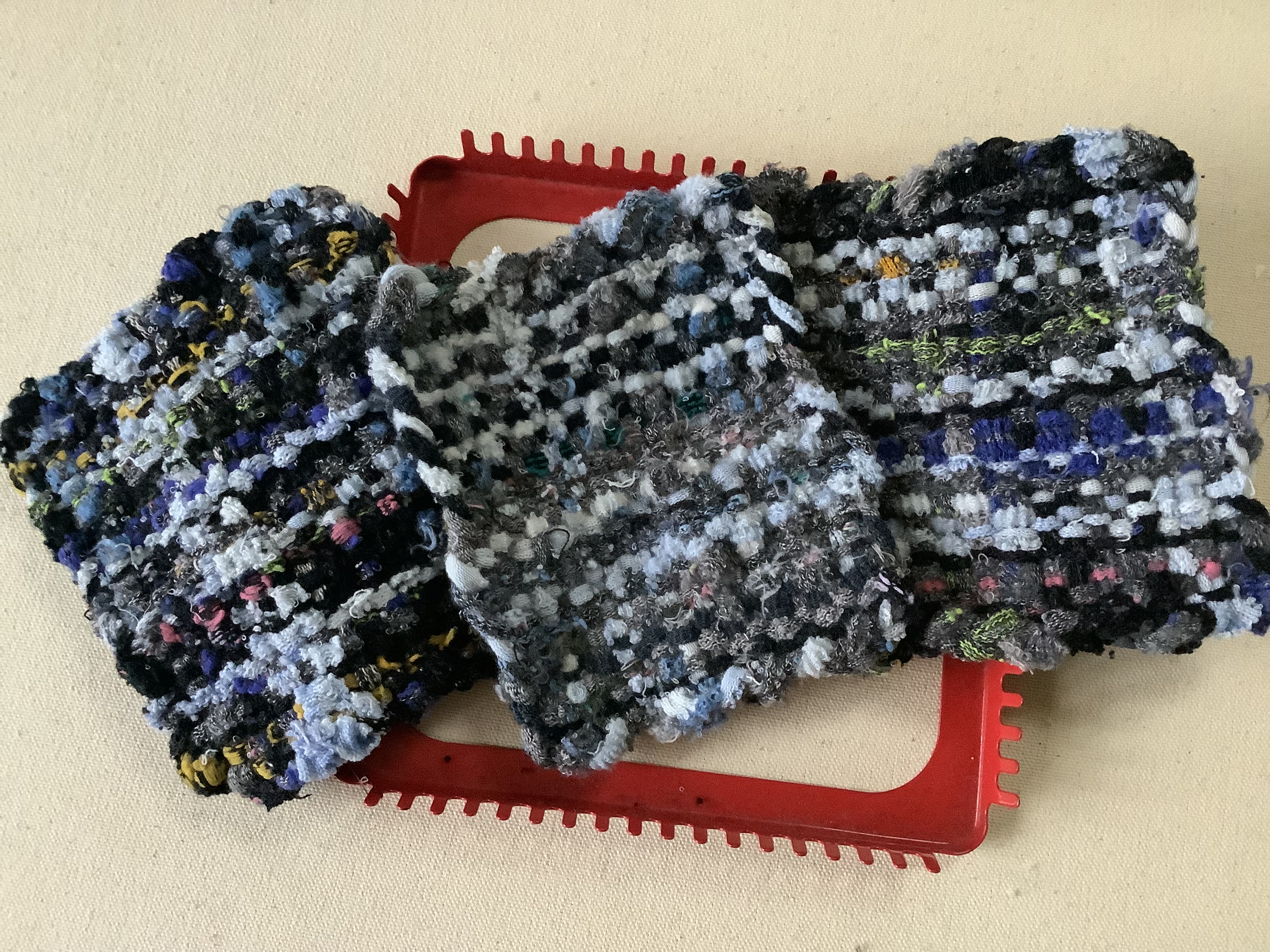
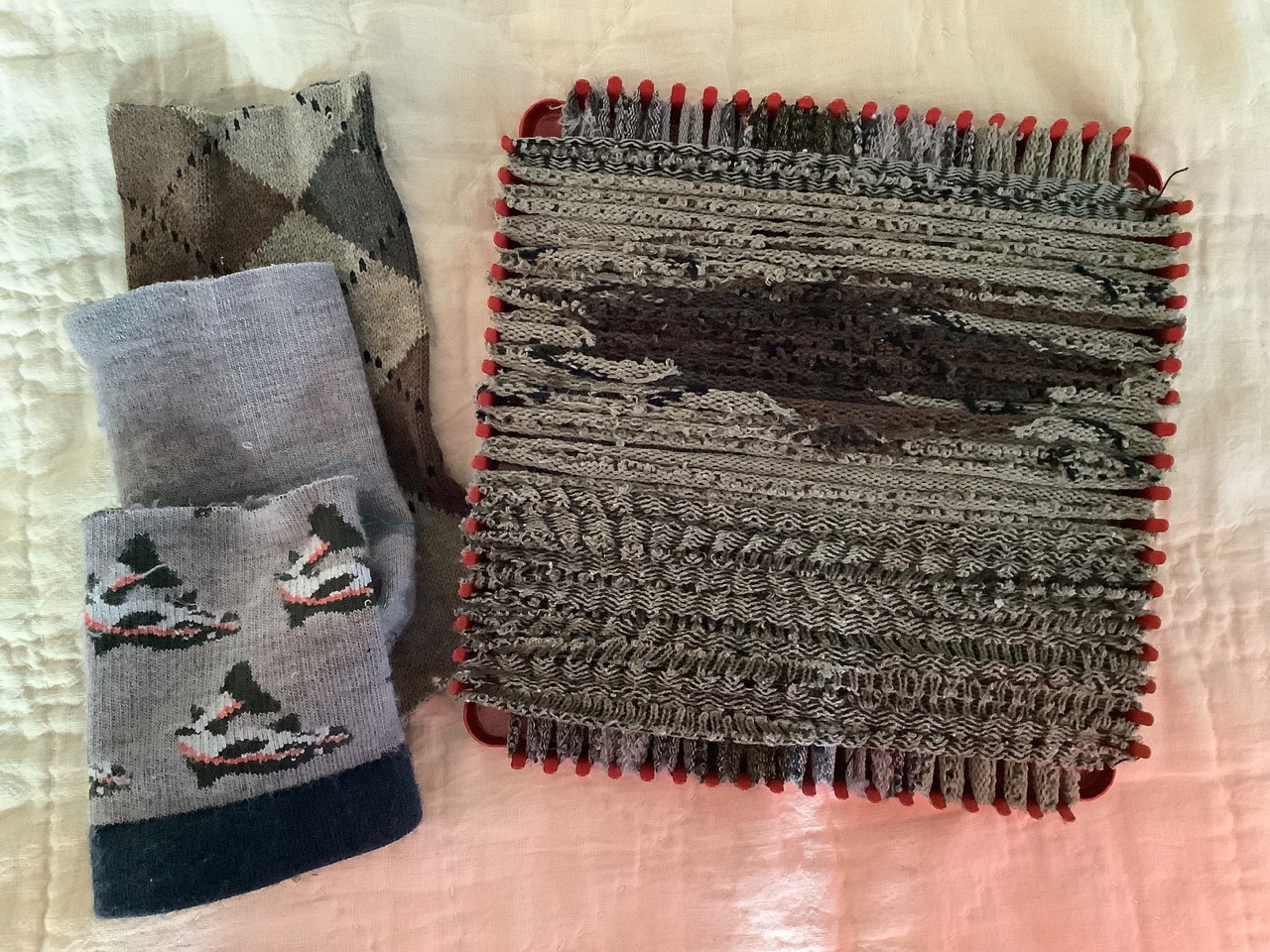
As long-lasting and hard-wearing our Bombas socks are, eventually the heels develop thin areas or holes. This weekend, I pulled out the Loopy Loom and a bag of un-mendable socks and started to weave with sock loops. A pair of light colored tie-dyed socks were incorporated with some of the darker colors. 

Weaving with light and dark color values on the Loopy Loom.

Because these socks have areas where the knitting has tighter elasticity, the weavings don’t come off the loom completely square. However, I think the organic shapes are interesting and fun (and a bit funny-looking). But they are thick and dense and make great hot pads and mug rugs. This batch is slightly more decorative because of the color combinations.

Three woven mug rugs off the loom.

So, cheers to the upcoming season of colder days, hot chocolate, hot tea with honey, and using a new set of upcycled mug rugs!


Sunday, October 15, 2023

Simple techniques yield big impact with texture and color

Don’t ya love projects that make a statement but are easy to make? These small projects use basic techniques, require minimal tools and supplies, and still make an impact because of their colors and textures.

Woven coaster and hand knit cotton dishcloths are easy projects.

Loopy Loom woven coasters

Tools and Materials: Loopy Loom, worn out socks, scissors, crochet hook

On occasion, I love to pull out my red Loopy Loom and weave a coaster or a pot holder from worn out or orphan socks. My metal Loopy Loom came with a long metal hook for weaving, but I use my fingers for the tabby (plain weave: over 1, under 1) weaving technique. Stripes and other patterns on socks add color and interest to the woven texture. 

Use the Zoom Loom and a pair of worn out socks.

I use a crochet hook to finish the looped edges after the weaving is complete. We use these small weavings for coasters (hot and cold beverages), hot pads/trivets, and pot holders. This is a wonderful re-purposing project and great way to upcycle unrepairable socks.

Hand knit dish cloths

Tools and Materials: cotton yarn (variegated, solid, or both), knitting needles, crochet hook, yarn needle for weaving in the yarn tails.

Hand knit cotton dishcloths.

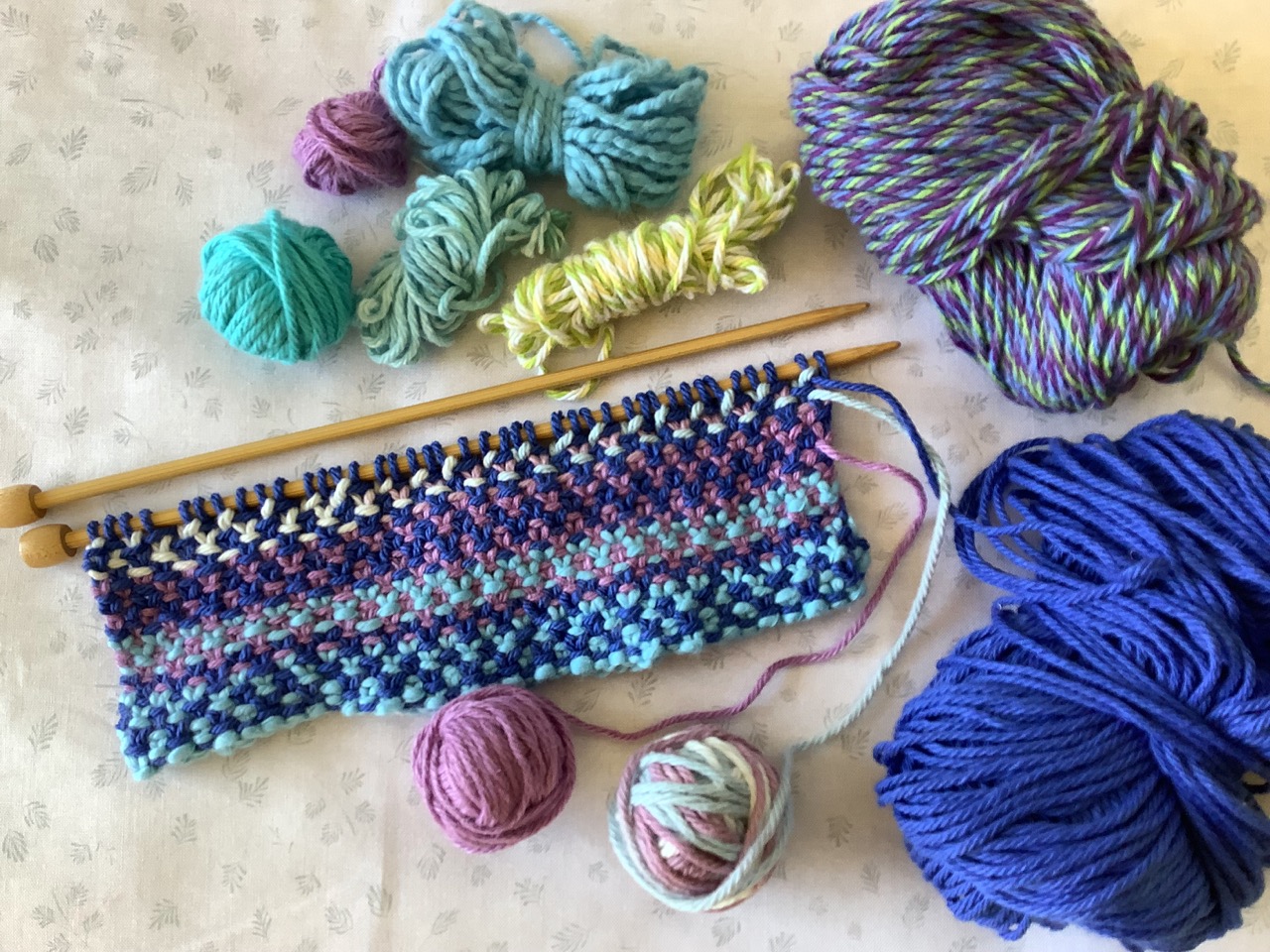
Using a linen stitch pattern, the slip stitch knitting technique creates a firm fabric and an interesting texture on these hand knit dish cloths. With a variegated yarn, there is an additional lovely color interchange created by the slipped stitches from the row below. This is the perfect stash-buster yarn project! Use up those extra little balls of yarn for a fun and useful project. 

A crocheted edge in single crochet or a slip stitch unifies the piece and finishes the edges. A yarn needle is helpful to weave in the yarn tails. 

Hand embroidery on printed fabric

Tools and Materials: embroidery floss, embroidery needle, embroidery hoop (optional), scissors, a fabric print

Basic embroidery stitches: back stitch, stem stitch, French knots, pistil stitch (long French knot), running stitch, straight stitch, blanket stitch.

Hand embroidery on a printed fabric panel.

Using fabric prints and fabric panels is NOT cheating. Capitalize on and enhance the printed motifs on fabrics. 

This is a cotton fabric panel from an upcoming holiday collection from FIGO Fabrics. Using 2 or 3 strands of embroidery floss, I’m embroidering around motifs and on the outlines. Any basic embroidery stitches will create beautiful textures. An embroidery stitch dictionary also has loads of inspiration for experimenting with new stitches. 

Hand embroidery on a printed fabric panel.

Choose floss in holiday colors, neutrals, brights, or colors from nature. Embroidery floss is inexpensive and readily available in a multitude of glorious colors. Or experiment with other beautiful threads such as perle cotton (various weights), cotton sashiko thread, and novelty yarns and threads. Got a thread stash? This is the perfect small canvas to use savored lengths and leftovers from other projects.

Hand embroidery on printed fabric panel.

These embroidered pieces can be backed and stuffed with a polyfill. A ribbon or yarn loop can be added to create holiday ornaments or gift decorations. Or they can be displayed as home decor in a festive bowl or basket.

Make small projects with big impact and happy stitching!


Sunday, December 18, 2022

Minimize textile waste with upcycled, scrap buster projects

I try my best to minimize fabric, yarn and clothing waste through scrap projects, mending and donating to charities. Looking around the house and my studio lately, I realized the variety of scrap buster projects—for both yarn and fabric scraps—that I worked on in 2022. These are favorites from this past year.

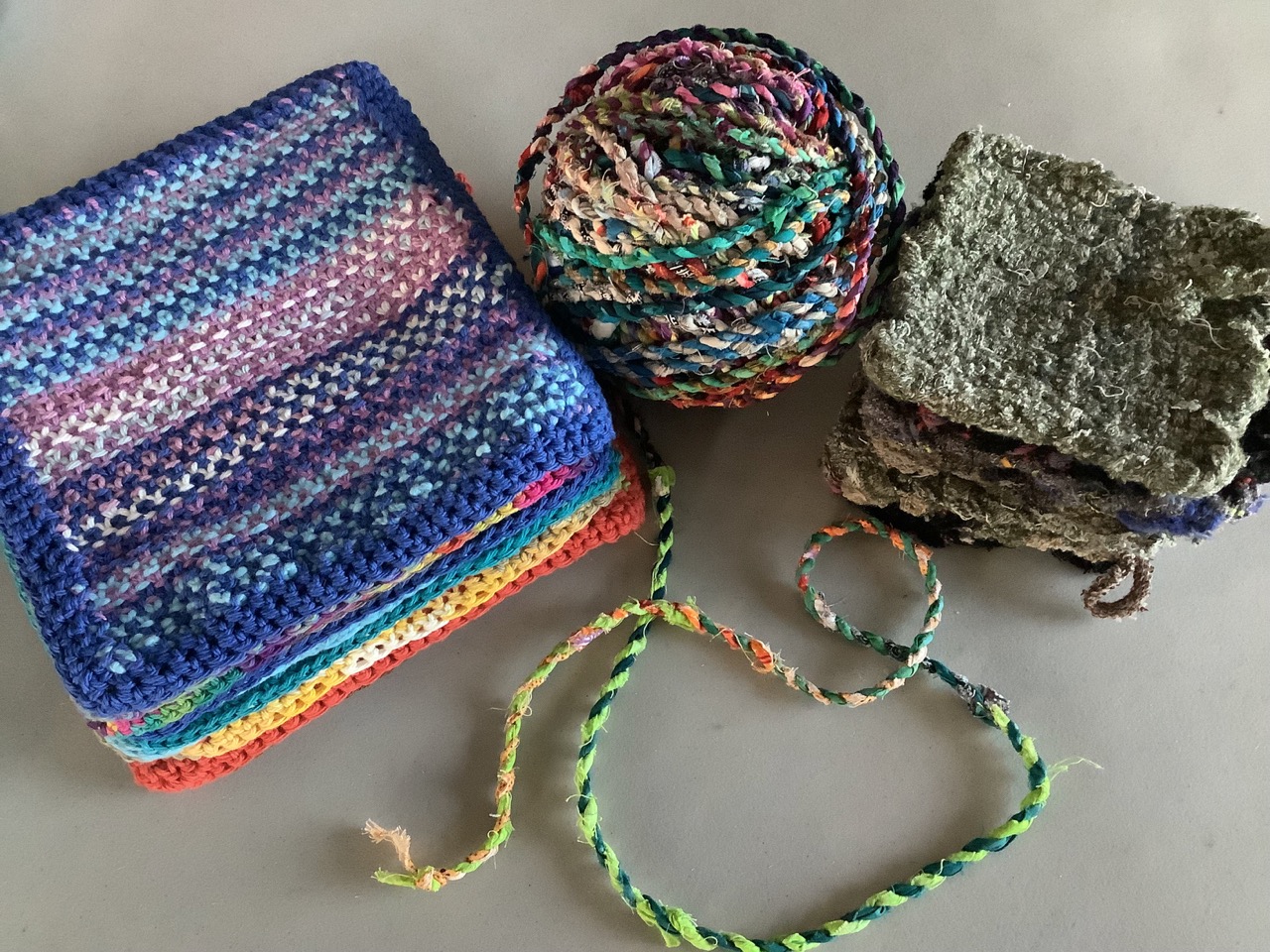
2022 upcycled and scrap buster projects: (from left) knitted dish cloths, fabric twine,
and Zoom Loom sock mug rugs.

Hand knit dishcloths

After discovering the Dishcloth Challenge from Modern Daily Knitting this summer, I got immersed in these scrap-busting, quick knits. Dishcloths are also a great portable project for travel. 

Cotton dishcloths use up multitude of leftover yarn scraps.

Combining small bits of leftover yarns, I enjoy the experimental practice of unplanned color combinations and the surprising results. I have mostly used the linen stitch because it's easy to remember, and the slipped stitches merge the yarn colors within a single row.

Fifteen colorful cotton dishcloths.

Cotton dishcloths qualified for my Slow Stitching Make Nine project in August, but I have continued making them through December. I like that these are colorful and pretty as well as functional.

Dishcloths: Slow Stitch Make Nine Project.

The last one is off the needles with just the crochet edge remaining.

Dishcloth ready for crocheted edge finish.

Fabric twine

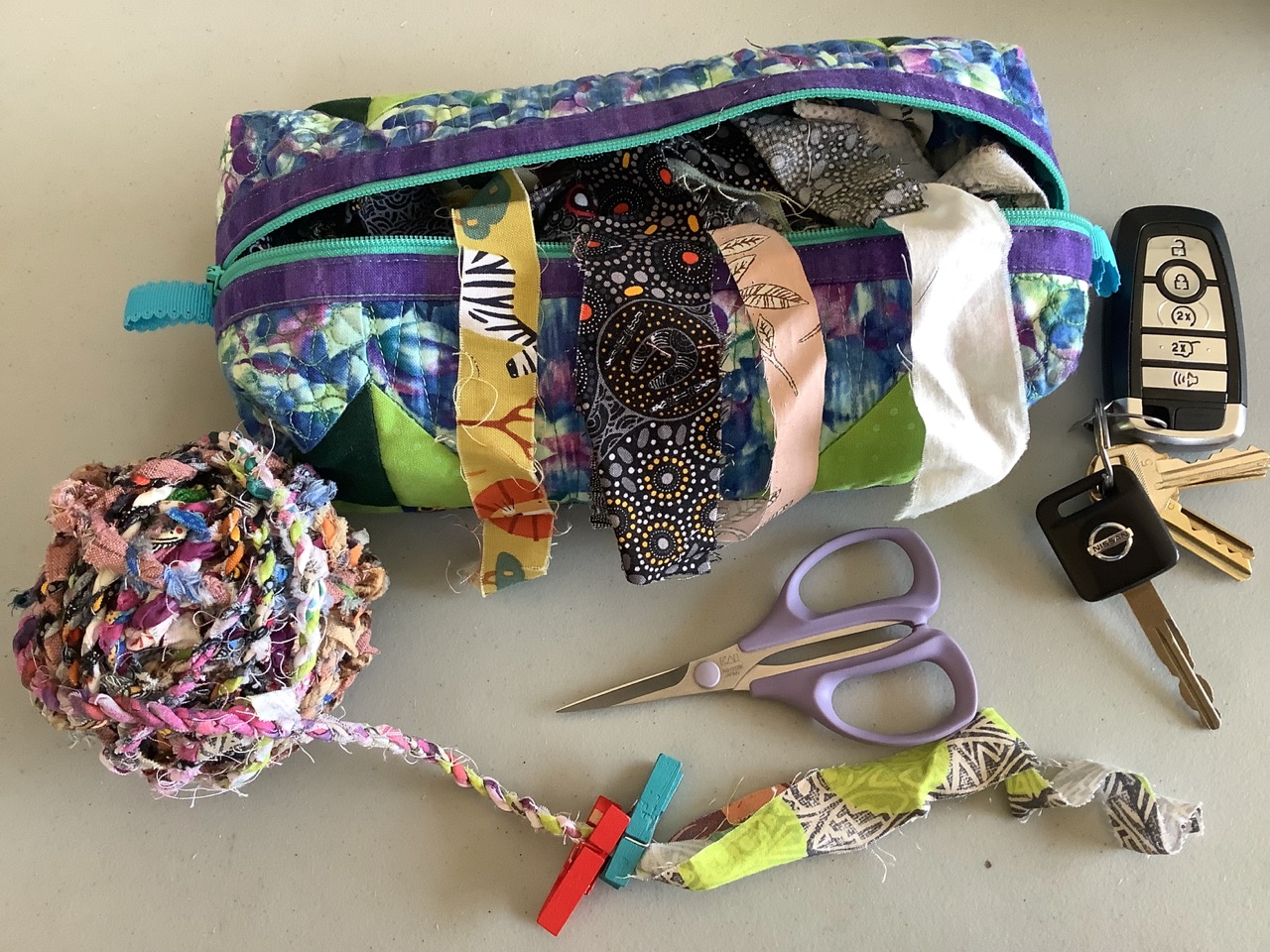
In 2021, I started making fabric twine with trimmings and strips from quiltmaking. Any fabric strip that is too thin to use for patchwork—especially if it's a long strip—is set aside for making twine. I've continued making twine this year. It's another good travel project.

Taking fabric twine supplies when traveling.

The Loopy Loom upcycles socks into coasters

A rediscovery of the Loopy Loom/Zoom Loom is converting old socks into woven coasters. 

Using the Loopy Loom for sock weaving.

I'm still experimenting with these as I've learned that some socks contain elastic and the loops stretch and contract at different rates. So, sometimes the coasters are slightly off-square.

Woven mug rugs from discarded socks.

But this project ticks all the sustainability boxes for me! It takes an un-repairable textile and converts it into a new, useful object. And these little coasters are thick and squishy and so very functional. They fulfilled my Mend/Upcycle prompt for Make Nine 2022.

Collection of woven sock coasters/mug rugs.

Improv patchwork kitty quilts

Of course, a wonderful scrap project is making kitty quilts and charity quilts. In 2022, sixteen kitty quilts were made and gifted to friends, the Cat Clinic of Chattanooga, or are enjoyed by our pack of adopted outside kitties. (Note, our kitties adopted us, not the other way around.)

Improv patchwork quilt top ready for quilting.

The kitty quilts fulfilled the Scraps and Crumbs prompt for Make Nine 2022. Not only are fabric scraps used to make these, but odd strips and pieces of batting are also patched together to make these quilts.

Four improv patchwork kitty quilts.

Twelve scrappy kitty quilts.

Scrap buster 2022 year-end tally

  • 19 cotton dishcloths
  • 8 recycled sock mug rugs made on the Loopy Loom
  • 16 kitty quilts
  • 4 cuddle quilts for the guild's community service project
  • yards and yards of fabric twine

A fulfilling year!


Related Posts Plugin for WordPress, Blogger...