Showing posts with label stash buster. Show all posts

Friday, May 22, 2026

Mittens fulfill my Make Nine “yarn” prompt this year

This year’s Make Nine “yarn” prompt has turned into something much bigger than I expected. What began as an idea to use up leftover yarn has become an ongoing mitten-knitting project slated for a winter charity donation. My initial goal was to knit 12 pair—one pair a month. As of this blog post, however, I’ve completed 16 pairs! To say this has been addictive is an understatement. 

A variety of knitted mittens using stash yarns.

Pattern construction approaches for knitting mittens

One of the unexpected parts of this project has been discovering the variety of construction approaches to knitting mittens: 

  • knit flat, 
  • knit in-the-round, 
  • knit just the thumb flat, 
  • the afterthought thumb, 
  • thumb gussets, 
  • elf thumbs, 
  • no-gap thumbs, 
  • various ribbing patterns for the cuff, 
  • stripes in the round, and 
  • infinite formulas for decreasing at the top.
These are a few of the outcomes.

“Basic Four-needle Mittens,” knit in the round.

“Knit Flat Kid Mittens” pattern.

“Margot Mittens” with an after-thought thumb.

“Elf Fit Mittens” pattern.

The “StopGap Mittens” pattern with added color changes.

I’ve explored many mitten patterns found on Ravelry and even though the finished mittens look similar, the pattern instructions have been varied and quite interesting to follow. Each pattern is indeed like a map for a treasure hunt. 

By working the various construction techniques, I’ve gotten more proficient at: 

  • joining in the round 
  • knitting in the round with two circular needles (vs knitting with a set of double points) 
  • picking up stitches (for thumbs and thumb gussets) 
  • left and right leaning decreases
  • learning tips for changing yarn colors. 

Every pair has exposed me to something new! 

Working with leftovers from the stash 

The mittens are mostly children’s and young adult sizes which make them suitable to working with leftovers and small yardage amounts. 

“Margot Mittens” (left) with colorwork, “Toddler Baby Mittens” (right).

Using a mix of stash yarns, orphan balls from the sale bin, and leftovers from a yarn swap also makes every pair unique and different. Some mittens are bright and playful, while others are simple and practical. The latest pair I just finished used a self-patterning yarn that created its own design as I knitted—making the process especially fun to watch unfold. 

Design, color placement, and “yarn chicken”

Determining pleasing color placement—based on available quantities of leftover yarns—has been challenging. Working from leftovers means I’ve also played plenty of “yarn chicken.” More than once I’ve watched a yarn skein dwindle and wonder if I’ll have enough to make it to the second mitten’s bind-off. 

The “No Gap” mitten pattern with colorwork.

A few pairs have come down to unrolling the remaining yarn to find the half-way mark and then rewinding into two separate yarn butterflies. So far, I’ve managed to avoid running out completely, but there have definitely been moments of “running on fumes…” hoping I didn’t run short. 

Running down to the last few yards of a self-patterning yarn.
“Basic Four-Needle Mittens”

It’s satisfying turning bits of yarn from the bottom of a basket into something useful. Small skeins that are too little for a whole project become colorful cuffs, stripes, or contrasting thumbs. 

“Mittens for All” (left) and “Crayon Striped Mittens” (right).

Mittens offer wonderful and imaginative opportunities that are adaptable to small amounts of yarn! I’ve even taken pairs of fingerless mitts, unraveled the bind-off edge and added closed mitten tops and thumbs.

Unraveling the bind-off edge of fingerless mitts to convert them into full mittens.

Converting fingerless mitts into full mittens.

A Make Nine 2026 “yarn” prompt

My Make Nine “Yarn” prompt has become part stash-busting, part technique practice, part design, and part opportunity to contribute to the community. 

Make Nine 2026 tracker, May 22, 2026.

One versus many

Charity knitting also changes the rhythm of making. Instead of focusing on a single large project, I can quickly finish a pair of mittens and then imagine someone wearing them on a cold morning. That sense of purpose keeps me reaching for my needles more frequently. 

Make Nine 2026 “yarn” prompt.

I still have more yarn to use and more mitten variations to try, so this project is far from finished. For now, though, sixteen pair feels like a great accomplishment for the mid-point of the year… and I’m counting this project as fulfilling my Make Nine “yarn” prompt.


Saturday, December 20, 2025

Make Nine 2025 photo recap

Although I completed Make Nine 2025 in October, I like to do a recap blog post of the year’s projects—to see photos of them all in one place and “compare and contrast,” the projects, so to speak.

Make Nine 2025 projects, fulfilling these prompts:
Top row: UFO, Mend/Upcycle, UFO
Middle: Make it Again, Simple and Stress-free, Online Challenge
Bottom: Wild Card, Yarn, Wild Card

Above is a photo grid of my completed projects. The grid corresponds to my Make Nine tracker (below). 

Make Nine 2025 tracker at the beginning of the year.


Make Nine 2025 summary

The prompts I chose for Make Nine 2025 were similar to past years. Interestingly, 2025 generated a lot of “books”—five in total—constructed with paper, fabric, or both. The remaining four finishes consisted of two wearables, a mended vintage quilt, and charity quilts—with a glorious batch of kitty quilts that get donated to local veterinarians. Below is how each prompt was fulfilled (left to right, from top left), with links to their stories.

  • Make it Again: I used a favorite Siena Shirt pattern and a fabric collection called, Perfect Points for this shirt. Blog posts about other versions of the Siena Shirt and various garment makes can be found here. (finish #4)

  • Simple and Stress-free: I continue to make scrappy, improv, charity quilts for the cats and dogs at the local vets. I donated 16 in March, and completed 3 additional during the remainder of the year. I also finished 3 cuddle quilts for charity in December. Total charity quilts = 23. (finish #2)

  • Wild Card 1: was another fabric book made through participation in an online Challenge, the 100 Day Stitch Book 2025. This stitch sampler book was the impetus for the UFO 1 project, which used the same bookbinding technique. (finish #5, book #2)

  • Yarn: I made a vow to myself that this year’s yarn project was going to be a stash-buster. I succeeded in using only yarn from a shop-and-swap, an impulse yarn purchase from several years ago, and yarns from my stash. The Taos wrap (crochet) was a brilliant success and I love the finished piece. (finish #9)

  • Wild Card 2: was another junk journal from participation in the Junk Journal July Challenge, an online challenge. This was my 5th junk journal. I enjoy making and working in handmade junk journals and I know I’ll be making more. (finish #8, book #4)

Make Nine 2025 tracker, December 20, 2025.

I’m pondering prompts for 2026—my 8th year! I may have to include a “bookmaking” prompt next time…


Sunday, October 12, 2025

Stash-buster crochet Taos wrap, final Make Nine for 2025

This is 9 of 9Make Nine, that is! My final project for 2025 for the “yarn” prompt is completed, blocked, and ready to wear.

My Taos crocheted wrap. Make Nine 2025.

My “yarn” prompt: pattern and project parameters 

In late Spring, I decided the "Yarn" prompt project for my Make Nine 2025 challenge was a commitment to use a collection of leftover yarns I had from a shop-and-swap. The parameters were:

  • a pattern intended for a variety of yarn colors, or one that could be adapted for my collection of disparate yarn leftovers (a stash buster), 
  • an easy-to-memorize pattern—something that required little concentration (no stitch markers, or the need to carefully count stitches),
  • a flexible finished size,
  • portable for traveling—perhaps something with modular units,
  • and, if possible, I wanted it to be a crochet project this year.

I mentioned my search for a portable, scrappy yarn project to Pati, the owner of Louisville Fiber Supply, a lovely yarn shop in Kentucky. She turned to her earmarked collection of patterns on Ravelry and shared inspiration with me. 

Make Nine 2025 “yarn” prompt: the Taos wrap.
16.5” x 66.5”

The Taos wrap

The pattern that had the most potential for what I was looking for was Taos by Cristina Mershon [found on Ravelry]. It checked all the boxes.

Shawls are perfect for stash-busting because they don't require exact yardage and can easily be made wider or longer with additional rows or blocks. The Taos wrap, with its modular units, could accommodate the diversity of colors and fibers that I planned to use up (for example, for fingering weight and sock yarns, I sometimes used two stands held together). The resulting piece would be a beautiful tapestry of my leftover balls and impulse buys! 

Swatching

 
Swatching the motif.

After doing a few test swatches of the units, I realized I needed to modify the pattern because my initial swatching efforts produced diamond shapes rather than the squares. I also needed to accommodate the different yarn weights of the leftover yarns. This meant being flexible with stitch count and adding border rounds of single crochet (if needed) to get them to a 2.75” size (the size of my units). This project was a true exercise in intuitive crochet.

Wrap stats

I worked on this Make Nine wrap from mid-August to early October. The finished piece incorporates yarns of many earthy colors that reflect nature’s end-of-summer to early-fall color palette.  

  • motif size: 2.75” square
  • 6 x 24 = 144 motifs
  • finished size: 16.5” x 66.5”

Here are “before” and “after” photos of the yarns used.

Collection of leftover yarns.

After completing the wrap:

Remaining yarn after the project’s completion.
Several small balls were completely used up. 

I incorporated these yarns from an impulse buy (before photo):

Impulse buy yarn.

I made a dent in reducing these—especially the two balls of the blue-green yarn that was used for joining and the edging. (I actually had to introduce one new blue-green yarn that very closely matched the original in order to have enough yarn to crochet the edging around the perimeter.)

Remaining yarns after completing the wrap.

One of the fun parts of making the motifs was using the variegated yarn. It had long color changes, so I could usually crochet the entire inner or outer motif section before the color changed. The color combinations reminded me of the changing colors of the leaves in the landscape—especially with the leaf-shaped motif of the Taos pattern.

Using a variegated yarn resulted in a variety of motifs.

One of the not-as-fun parts of making many independent motifs with two colors of yarn is weaving in the tails. With 144 motifs… there were A LOT of tails! Here is my thread tail jar [ORTs (odd random threads) jar] from making Taos

Empty mayonnaise jar with yarn tail cut-offs—ORTs.


The picot edge

The final detail, and perhaps my favorite, is the picot edge. The edge had 3 rows of single crochet plus the picot row. 

Pico edge detail.

This simple, elegant border treatment provided a beautifully finished look that added a delicate little design element to the wrap. It took minimal extra time to crochet the picot edge, but that detail was so worth it!

Taos wrap with a picot edge.

A stash-buster project is the perfect way to honor the yarn you already own by turning “potential” into “purpose” in a truly unique item. This one came together in a harmonious color story that was not planned, but worked out very well.

I was able to finish and block my new wrap just in time to show it to Pati when I visited her shop again this past week. 


Make Nine 2025 is complete

Make Nine 2025 is “a wrap” (so to speak). I finished this Challenge earlier than usual (in October) and will be looking forward to Make Nine 2026. I’ll post a Make Nine 2025 recap—with photos of all 9 projects—some time before the close of this year.

Make Nine 2025 tracker.

Every year, the Make Nine Challenge pushes me to tackle a new technique, work with a new material or art supply, try a new-to-me pattern, or finish projects languishing on my to-do list. Each project and finish is very rewarding. 

If you’ve been thinking about doing Make Nine or tackling your fabric or yarn stash, let this be your sign of encouragment. Sometimes the best projects are the ones you build from what you already have—and the people who inspire you along the way.


Sunday, September 14, 2025

Stash busting on-the-go: a scrappy crochet wrap

One of my favorite things about crochet (and knitting) is how easily it travels. Whether I’m on the road in a hotel room, or catching a few quiet moments outdoors, this small project has quickly become my portable, go-to project—and it’s made entirely from the yarn stash. 

Crocheted modular leaf blocks.

Fulfilling my Make Nine “yarn” prompt

Since early this Spring, I had been searching for a stash-busting project to fulfill my Make Nine 2025 “yarn” prompt. I wanted to use up a stash of odd, abandoned balls of yarn that I collected from a swap shop. I’m combining them with an “impulse buy” that never found a home. It turns out that when putting these stash bin finds together… something beautiful is happening. 

The collection of abandoned balls of yarns.
An “impulse buy” from the sale bin at a yarn store.

The Taos pattern

I modified a crochet pattern [Taos by Cristina Mershon, found on Ravelry] to make the leaf-shaped modular blocks. I’m also having to adjust on-the-fly to compensate for the different yarn weights/thicknesses—sometimes holding two yarns together, or crocheting and extra row around the perimeter to get size.

The format of the modular blocks is perfect for portability. The pattern is easy to memorize, and each block becomes its own little surprise when choosing different yarns. I’m especially intrigued with how the variegated yarns play out in these blocks—the color shifts in the skein produce a new color combination every time.

The leaf-shaped centers of these units were created from the same ball of variegated yarn.
They all look different.

My units finish at about 2.75”. While I don’t know the exact finished format and size or the wrap yet, I’m leaning toward a rectangular shawl that I can toss on around my shoulders in cooler weather—something cozy and full of color. The Taos pattern is an L-shape wrap, so that’s an option, too. Either way, my wrap will be a wearable memory of abandoned bits. The yardage of the odd balls, along with the impulse buy, should yield an ample size.

Portable yarn project: tools and supplies in a zipper pouch.

My crochet hook, yarn needle, and yarn stash are packed in a small zipper pouch. For now, I’m just enjoying the crochet process, exploring color combinations, and making bunches of leaf units.


Sunday, October 15, 2023

Simple techniques yield big impact with texture and color

Don’t ya love projects that make a statement but are easy to make? These small projects use basic techniques, require minimal tools and supplies, and still make an impact because of their colors and textures.

Woven coaster and hand knit cotton dishcloths are easy projects.

Loopy Loom woven coasters

Tools and Materials: Loopy Loom, worn out socks, scissors, crochet hook

On occasion, I love to pull out my red Loopy Loom and weave a coaster or a pot holder from worn out or orphan socks. My metal Loopy Loom came with a long metal hook for weaving, but I use my fingers for the tabby (plain weave: over 1, under 1) weaving technique. Stripes and other patterns on socks add color and interest to the woven texture. 

Use the Zoom Loom and a pair of worn out socks.

I use a crochet hook to finish the looped edges after the weaving is complete. We use these small weavings for coasters (hot and cold beverages), hot pads/trivets, and pot holders. This is a wonderful re-purposing project and great way to upcycle unrepairable socks.

Hand knit dish cloths

Tools and Materials: cotton yarn (variegated, solid, or both), knitting needles, crochet hook, yarn needle for weaving in the yarn tails.

Hand knit cotton dishcloths.

Using a linen stitch pattern, the slip stitch knitting technique creates a firm fabric and an interesting texture on these hand knit dish cloths. With a variegated yarn, there is an additional lovely color interchange created by the slipped stitches from the row below. This is the perfect stash-buster yarn project! Use up those extra little balls of yarn for a fun and useful project. 

A crocheted edge in single crochet or a slip stitch unifies the piece and finishes the edges. A yarn needle is helpful to weave in the yarn tails. 

Hand embroidery on printed fabric

Tools and Materials: embroidery floss, embroidery needle, embroidery hoop (optional), scissors, a fabric print

Basic embroidery stitches: back stitch, stem stitch, French knots, pistil stitch (long French knot), running stitch, straight stitch, blanket stitch.

Hand embroidery on a printed fabric panel.

Using fabric prints and fabric panels is NOT cheating. Capitalize on and enhance the printed motifs on fabrics. 

This is a cotton fabric panel from an upcoming holiday collection from FIGO Fabrics. Using 2 or 3 strands of embroidery floss, I’m embroidering around motifs and on the outlines. Any basic embroidery stitches will create beautiful textures. An embroidery stitch dictionary also has loads of inspiration for experimenting with new stitches. 

Hand embroidery on a printed fabric panel.

Choose floss in holiday colors, neutrals, brights, or colors from nature. Embroidery floss is inexpensive and readily available in a multitude of glorious colors. Or experiment with other beautiful threads such as perle cotton (various weights), cotton sashiko thread, and novelty yarns and threads. Got a thread stash? This is the perfect small canvas to use savored lengths and leftovers from other projects.

Hand embroidery on printed fabric panel.

These embroidered pieces can be backed and stuffed with a polyfill. A ribbon or yarn loop can be added to create holiday ornaments or gift decorations. Or they can be displayed as home decor in a festive bowl or basket.

Make small projects with big impact and happy stitching!


Sunday, February 26, 2023

The Inclinations Shawl—a Make Nine finish

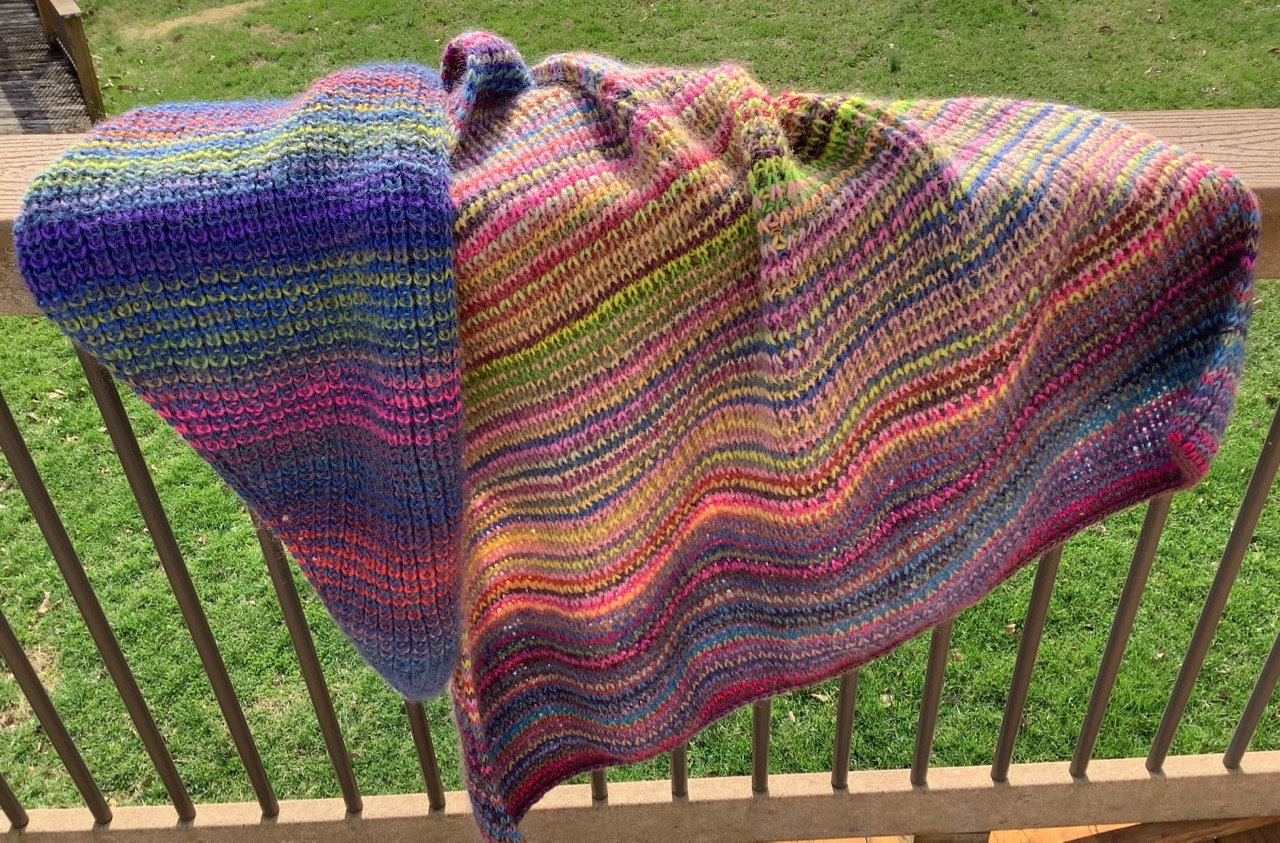
 My Inclinations Shawl, a stash buster yarn project for Make Nine 2023, is finished (and not without a few froggings)!

Make Nine 2023 finish: yarn stash buster project, the Inclinations Shawl.

This is my second Make Nine 2023 finish, and fulfills the stash buster prompt. You can't go wrong with a stash buster project that also has stripes. It's always an exciting knit!

Inclinations Shawl, a stash buster project. 68" x 42.5"

2-row stripes with variegated yarns

At first, I thought I'd use a monochromatic blue yarn [Classic Shades from Universal Yarn] and interject brighter, more colorful stripes using Poems [Universal Yarn]. However, the more the variegated colors of Poems interacted, I became fond of the colorplay effects achieved within the single skeins.

Starting the Inclinations Shawl.

So, after the Classic Shades skein was used up, I busted through various skeins of Poems and let the colors in this variegated yarn play on its own terms across the rows. This is how the center glow was achieved with the lighter colored skeins of Poems.

Inclinations Shawl showing the lighter colors in the center.

I busted through 10 skeins of yarn from the stash. A nice dent, I'd say.

Over 10 skeins of yarn used.

When the remainder of the 10th skein of Poems was all brown and all the same value, I stopped knitting. By this time, I had 174 stitches on the needle and the shawl was well over 75" on the diagonal side. The last color change was a stripe of bright magenta... and ending on a bright note was my signal to wrap it up.

Striped, I-cord bind-off.

In the pattern, there were several options for a bind-off.  I chose the 2-yarn, striped I-cord version. The bind-off took quie a long time, but well worth the investment. 

Project Stats

Here are the specs for my Inclinations Shawl:

  • Over 10 skeins of worsted weight yarn: 9+ skeins of Poems [100% wool, 109 yd, 50g]; and 1 skein of Classic Shades [30% wool, 70% dralon, 197 yd, 100 g]
  • finished size: 68" x 42.5" with a hypotenuse of 78" (unblocked)
  • size 5 needle
  • 174 stitches at the bind-off
  • 262 rows.

Frogging did occur!

I had a difficult time figuring out how to fix errors with the half Fisherman's rib stitch. The floats that are created when you knit the stitch below made it confusing for me. I tried a couple of times if I caught an error in one row beneath, but going down several rows was chaos.

Trying to fix mistakes several rows below was not successful.

Frogging did occur. Twice. With about 3 - 4 inches of knitting each time—at the wider side of the shawl. Not fun, but a cleaner result once it was re-knit. Luckily, the "stickiness" of the wool yarn helped preserve the live stitches so it was easier to get them back on the needle after ripping out the rows.

Frogged!

Make Nine 2023 progress: 2 of 9

This is my second Make Nine project for this year. It was finished 3 days prior to the start of The 100 Day Project in which I am participating. 

Make Nine 2023 worksheet: stash buster prompt fulfilled.


My Inclinations Shawl.

I've used this shawl several times already. It's warm yet light weight, squishy and snuggly. I love the color changes and I'm happy to have created something new with stash and leftover yarns.


Related Posts Plugin for WordPress, Blogger...