Showing posts with label repurpose. Show all posts

Saturday, June 6, 2026

Repurposing is finding a better plan! Make Nine finish #4

Another UFO [unfinished object] has found a new purpose! And I’m using it to fulfill my UFO prompt for Make Nine 2026.

A repurposed UFO turned into a functional storage roll for double pointed knitting needles.

While straightening up my studio, I uncovered a partially finished placemat from a few years ago. It was going to be a store sample (showcasing a collection from Art Gallery Fabrics) but I never really loved the look of this patchwork—the pieces felt a bit too small and fussy for a placemat—and it wasn’t an enjoyable project for me to make. Because of my mitten knitting charity project, however, this UFO turned out to be perfect for something else. 

The unfinished placemat and additional fabric pieces
gathered to create a new holder for knitting needles.

Knitting mittens in the round has resulted in frequent use of double pointed knitting needles [dpns]. 

I often use double point needles [dps] for knitting mittens in the round.

The old leather pouch that kept them had reached the end of its life, cracking and shedding flakes every time I picked it up. I needed a better storage solution. 

New needle holder (left) and previous worn-out needle holder (right).

Repurposing a placemat UFO

Why not repurpose the unfinished placemat into a knitting needle holder??? One UFO would be brought to the finish line and I’d have new storage for my knitting needles. Win-win! 

Auditioning thread for the pocket stitching. 
Straight pins mark the position for the stitching.

The unfinished placemat was already quilted—which made the project so much quicker to complete! I combined it with other fabric bits that I found while organizing: an orphan quilt block with colorful Australian aboriginal fabrics [M&S Textiles USA], and a fabric sample from a past surface design workshop. Fabrics for the binding and the pocket’s lining were added to the mix.

Creating the pocket for the needle holder.

The placemat was trimmed, the pocket attached, and machine stitching created sections in the pocket for sets of dpns. The binding was attached on three sides. Because of the patchwork on the former placemat, it was easy to follow seam lines to create the pocket sections. I think this remake was meant to be!

This UFO was an easy repurposed project and now I have a reminder of two favorite fabric lines, and a workshop sample has found its way into a project. All good memories. 

A binding was attached on three sides.

Repurposing UFOs: finding a better plan

This needle roll is actually the second UFO I've repurposed this year. Earlier, I took a patchwork piece that was originally intended for a tote bag, cut it, and added additional fabrics to make a cat quilt for the animal center. In both cases, letting go of the original plan helped each project become something useful and more meaningful… as well as finished!

A new needle roll for my double point needles and two hand-knit pairs of mittens.

The placemat will never become what it was originally intended to be, but as a needle roll it will get far more use. Repurposing these unfinished projects has been a good reminder that finishing doesn't always mean following the original pattern or plan—it can mean finding an even better one. 


Make Nine 2026, 4th finish

This project is my fourth Make Nine finish—fulfilling the UFO prompt.

Make Nine 2026 “UFO” prompt.

Here is my Make Nine tracker as of the end of May.

Make Nine 2026 tracker, May 2026.


Sunday, July 10, 2022

Upcycle your argyles with a loom! Make Nine finish #5

If the socks in the laundry basket are really too far gone to mend, here's a fun idea to remake them into something useful. 

Ready? Get out the scissors! 

The worn sock remake.

Cut the socks into tubes...

Socks cut into tubes.

and weave them.

Weaving with a mini loom and sock tubes. 


The potholder loom keeps worn socks out of the landfill

Remember those rainbow-colored fabric loops and the mini weaving loom you had as a kid? They still make them! I have a shiny new red metal one. And now I'm cutting up worn-out socks to make the loops for the warp and weft. 

Those worn socks get a new life as a mug rug or hot pat and avoid the fate of ending up in a landfill. It's a great repurposing project, earth friendly, and quick and fun to do as well.

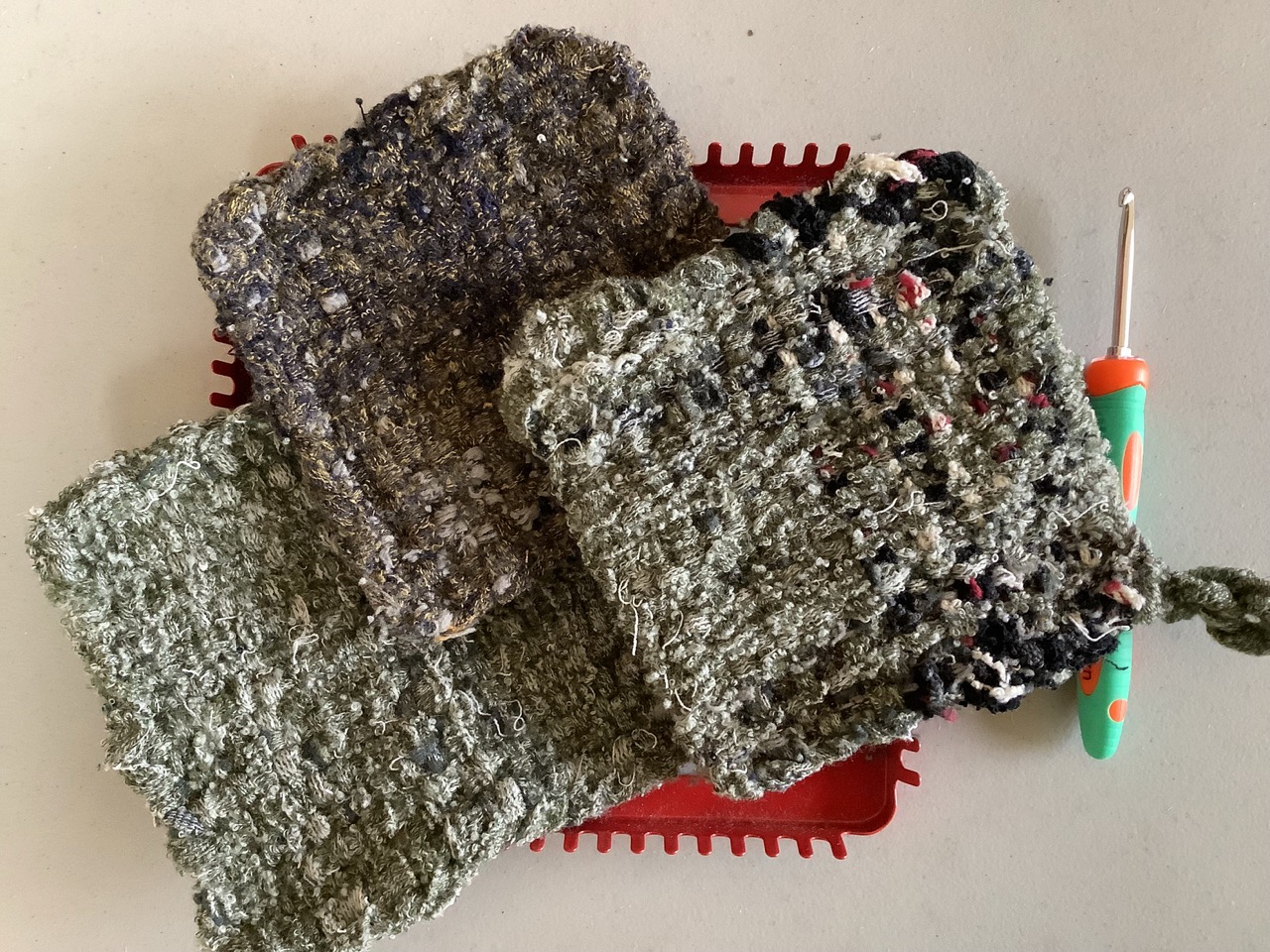
Three woven hot pads, metal weaving loom, and crochet hook for binding off.


The weaving process and design options

The weaving set-up and process is the same as when you were 7 years old. If you don't remember, there are instructions/illustrations online or that come with the loom.

My sock tubes were cut about 3/8" wide and it took most of two adult size, short, ankle socks to yield enough loops for my 7" square loom. If you're cutting up knee socks, there will be plenty of loops for one woven square and enough to start the next.

Cutting socks into tubes. The argyle will provide a contrasting color.

If your socks are various colors or prints, try blending them to create stripes and plaids. You'll see a change in color but the pattern of the old sock—like the argyle pattern—becomes obscure through the weaving process.

The weaving process on the mini loom. 

The loom is portable. I can weave on a table or in my lap. I accomplished the "bind off" with a crochet hook.

Binding off with a crochet hook.

The finished hot pad is between 5" - 5.5" square once it's been released from the tension of the loom. You can see the difference in size between the 7" loom and the finished piece.

The finished woven hot pad is approximately 5" square.

The loom came with a metal hook for weaving, but I found weaving with my fingers worked really well. 

I haven't tried it, but the woven squares could probably be stitched or crocheted together to make a larger piece if one desired. For now, I'm using the pieces straight off the loom as hot pads and mug rugs.

Three woven hot pads/mug rugs made from worn out socks.


My 5th Make Nine finish for 2022

Although I have mended quite a few projects this year—shirt collars, shirt sleeves at the elbows, T-shirt hemlines and necklines, toes of socks, the buttonhole on a pair of jeans—I'm going to count this old-sock re-make as fulfilling my "Mend/upcycle" prompt for Make Nine 2022. It's a blast from the past and still as much fun now as it was as a kid.

Make Nine 2022 worksheet, July 2022.

I hope you find the "joy of making" as exciting now as when you were a kid!


Sunday, September 19, 2021

The Tablecloth Jacket: the epitome of repurposing

One of the September Textile Love 2021 prompts, "Repurpose," reminded me of a jacket I made in a 2015 workshop with Angelika Werth. The workshop was called Garments: Deconstruction / Reconstruction. And this piece is the epitome of repurposing!

The Tablecloth Jacket, from a 2015 workshop with Angelika Werth.

If you hadn't read the title of this blog post, would you have known this jacket was created from a large, oval tablecloth and a pair of embroidered capri pants? I bet not. But it was!

The Tablecloth Jacket, back view.

Inside/Outside

Oh, I wish I had a photo of the tablecloth before it was "repurposed." A photo would make this easier to describe. Anyway...

During a show-and-tell session during the workshop, my classmates suggested I use the "wrong side" of the tablecloth—the faded denim side—for the outside of the jacket. The dark blue inside of the jacket was actually the "right side" of the tablecloth. Don't ask how many times I "unstitched" a seam by adhering to the sewing adage of "with right sides together..."! In this project, the "right side" was not necessarily always the right side.

The "wrong side" of the tablecloth is the outside of the jacket.
The design in the darker blue is actually the "right side" of the tablecloth.


Capri pants = jacket sleeves

The next "repurposed" element was an embroidered pair of capri pants. The pants were deconstructed and turned into the jacket's sleeves. The color of the pants as well as the floral embroidery were a perfect complement to the tablecloth!

Decorative embroidery on the capri pants.

The vent at the lower edge was a delightful "bonus" detail! 

The deconstructed pants turned into the jacket sleeves.


Jacket details

Looking at the back of the jacket, note the decorative braid-like pattern up the center back. The braid pattern was made from two rope designs that were running lengthwise at the 1/3 and 2/3 points of the tablecloth. The center section of the tablecloth had no design. I cut the center away and pieced the ropes to run up the center back—making it a braid.

Center back braid design and hand stitching at the shoulder seams.

Below is the inside of the jacket showing the center back. The raw edges of seam allowances at the center back are covered with a silk bias strip (cut from a silk blouse/dress). The little bows are a sweet detail and the color was perfect.

Bias trim covers the center back seam allowances.

The armhole raw edges and side seams are also covered with a silk bias strip.

Other construction details as well as serendipitous design elements include an open "gusset" at the underarm. You would only notice this if the arm was lifted... and you knew to look.

Underarm open gusset.

The pant leg sleeves were attached to the bodice with decorative stitching.

Open underarm and hand stitched seam.

The floral filigree design on front lapels is asymmetrical. One lapel is pieced on the diagonal.

Asymmetrical designs on the jacket lapels.

The lapels actually use the "right side" of the tablecloth—the darker blue—as the "right side" of the lapel. It makes a nice contrast and creates a long vertical line in the garment.

The dark blue lapel is a nice contrast to the bodice and sleeves.
It visually creates a long vertical line on the body.

I can't believe how the capri pant legs were the perfect length for the sleeves!

Capri pants = jacket sleeves! The perfect sleeve length.

Resources

The pattern I used as a basis for the body was the Santa Cruz Jacket/Vest pattern from the ReVisions collection by Diane Ericson. I did make a muslin for fit before cutting into the tablecloth.

The tablecloth and capri pants were acquired at a local resale shop. The silk bias strips were created from a silk dress that one of the class participants did not want.

My deconstructed/reconstructed Tablecloth Jacket, completed in 2015.

So, there you have it! My deconstructed/reconstructed Tablecloth Jacket. Simply serendipitous and totally repurposed!

Angelika Werth was a generous instructor with a wealth of knowledge and experience. My classmates were encouraging and supportive. It was a success all around!


Friday, August 6, 2021

The Nine Lives top with Kangaroo Path

Do Kangaroos have nine lives? I don't know, but my new Nine Lives top [pattern by The Sewing Workshop] uses the lively yellow Kangaroo Path print from M&S Textiles Australia and I just love it! Paired with the smoky blue-grey Lillup Dreaming (ash colorway) print [M&S Textiles Australia] and my repurposed vintage buttons... it's perfect in every way.

My new Nine Lives top with fabrics from M&S Textiles Australia  and repurposed vintage buttons.

The Kangaroo Nine Lives top: details and modifications

I've made the Nine Lives top several times. With only a four basic pattern pieces, it offers plenty of potential for customization, modification and embellishment. My "kangaroo" version has these mods: 

  • a front patch pocket,
  • an appliqué accent at the shoulder,
  • a side vent,
  • high/low front and back hems,
  • straight hem.

Design details: appliqué on right shoulder and a left breast patch pocket.

The blue ash color of the Lillup Dreaming fabric print is what initially inspired me to make this top. The golden yellow Kangaroo Path was a serendipitous accompaniment.

Back view of the Kangaroo Nine Lives top with ash colorway of Lillup Dreaming

I'm particularly fond of the contrast fabric on the breast pocket. It balances the appliqué on the right shoulder. The contrast fabric collar, pocket accent and appliqué bring the back fabric to the front of the garment.

Details: side vent and high/low hems.

The vintage buttons—a wonderful find at a resale shop—added another complementary detail to this top's color story.

Repurposing vintage buttons from a resale shop.


Close-up of the vintage buttons.

By hand and machine

Lately I've been enjoying a lot of hand stitching—big stitch quilting, kantha, and garment finishing techniques. The handwork on my Kangaroo Nine Lives includes:

  • an appliqué embellishment,
  • finishing the front and back hems.

The machine sewing includes:

  • the garment construction, 
  • patch pocket, 
  • buttonholes and attaching the buttons,
  • the seam allowances were finished with a serged edge.

Nine Lives top with the Valencia pants.

A me-made garment for August!

I am quite pleased to start off the month of August with a new me-made top! The summer weather is still upon us, so I foresee many opportunities to wear my kangaroo top. In the above photo, I'm wearing the Valencia Pants [The Sewing Workshop pattern] with my new Kangaroo top. In "kangaroo" style, both the pants and the top have had pockets added! (wink, wink.)

The Nine Lives Vest pattern [The Sewing Workshop]
and Kangaroo Path fabric from M&S Textiles Australia.

This is the fourth version of the Nine Lives pattern that I've made. My first Nine Lives top was made as the pattern instructed with an assymetrical hem. Alas, this version is not documented on my blog.

Version 2 was made with a pintuck fabric.

Dare I make 5 more?


Sunday, September 22, 2019

Orphan block Zippy Pouch: another Make Nine finish

This month, my guild, the Choo Choo Quilters, had a program about adopting and embracing orphan blocks and ideas for using them in projects. Orphan blocks—we all have them. They're tucked away in drawers, bags and boxes in the sewing room, they're the test blocks made before deciding to make a full quilt, the blocks from a class you took 5... 10... or 15 years ago, or maybe you rescued someone else's quilt blocks or vintage quilt top at a yard sale or e-Bay. Sadly, many of us have those lonesome misfits that never quite made it into a finished project.

One block Zippy Pouch made with an orphan quilt block.

As I have "collected" quite a number of miscellaneous quilt blocks and rescued and repurposed several abandoned quilt tops over the years, I offered to help with the program. While gathering my examples, this lonely block resurfaced. I decided to give the re-purposing process a go and make this orphan into a useful item—a zippered pouch. A zippered project bag also happens to be one of my Make Nine Challenge projects. Serendipity! I got twice the bang from this one block.

Repurposing an orphan block
The pattern I used was the Chunky Wee Zippy Pouch by Sam Hunter of Hunter's Design Studio. This is a great pattern as it not only has instructions for three sizes and shapes (see photo above), but provides a formula for making a custom size. (Visit your local quilt shop and ask for this pattern or support the indie pattern designer and purchase from her website.)

The size of my orphan block was 12.5" unfinished. Here is the quilted sandwich.
Quilted orphan block for zippered pouch.

The backing—which ends up being the inside of the pouch—was another random fabric bit from my stash.

Quilted block (inside). Examples of different free-motion fillers, a zigzag
and using rulers to stitch in the ditch can be seen.

A single fold binding was attached in preparation for sewing in the zipper.

Orphan block quilted, trimmed and ready for zipper insertion.

In addition to the orphan block, the materials used in the project were all scraps.

Finished zipper pouch.

Benefits of creating with orphan blocks 
As I worked through this project, I was reminded of several benefits to using these orphan UFOs [unfinished objects] in a project.
  • you get a jump-start to making a project. Part of the work is already done! (by you or by someone)
  • a small project offers an opportunity to practice free-motion quilting.
  • it offers an opportunity to experiment with different FMQ designs. Try a different motif in each section of the patchwork.
  • you can practice new quilting techniques: rulerwork, quilting in the ditch, walking-foot quilting, etc.
  • this project gave me practice with inserting a zipper.
  • a single orphan block can be combined with other orphan blocks, and/or combined with scraps from other projects.
  • If your orphan is a rescue, it's fun to collaborate with other (anonymous) quilters.
  • It's rewarding to recycle and give a new purpose and meaning to a languishing block or blocks.
Finished Zippy Pouch made from a single 12" quilt block.

It was fun to refashion an unused quilt block into something new and useful. Several guild members showed examples of pillows, tote bags, needle books, and the like that they created from orphan quilt blocks and fabric bits. Put on your thinking cap and you will be pleasantly surprised.


Sunday, January 21, 2018

Reengineering and repurposing a boring table runner using Quilt-As-You-Go [QAYG]

Re-engineering a table runner into a small quilt using Quilt-as-You-Go.
As a more experienced free-motion quilter, I like the potential that a full, wide-open, uninhibited quilt top "canvas" has to offer for quilting. So the QAYG [quilt as you go] piecing/quilting method is not a go-to technique for me. Yes, it has a place and advantages, but I don't gravitate toward this quilting method.

However, I recently ran into a situation—while creating order from chaos in my studio—where steps from the QAYG method was a good solution.

A boring table runner
I had a runner that was made with a pre-cut strip set. It was quilted in the ditch. It wasn't used... it was kinda boring. So with a 2018 goal of "use it up or give it up," I decided to reengineer and repurpose it as a kitty quilt for the cats at the Cat Clinic of Chattanooga. Here's the original runner (sorry—not a good photo).
Original runner 36" x 16".

The reengineering operation
To fit the cubbies at The Cat Clinic, the size of the runner needed to be converted from a long, skinny rectangle to something closer to 25" x 27".
Cut up and re-sewn quilt.
  • First, the binding was detached from most of the perimeter and 3 of the corners. (A productive use for the seam ripper!)
  • With the rotary cutter, a piece from one end was whacked off. 
  • From fabric scraps, two mini quilt sandwiches were constructed and added to the whacked-off piece.
  • Using the QAYG method for attaching pre-quilted squares together, the new piece was attached to the original section along one long side... making the new kitty quilt a more appropriate size. 
  • As with QAYG, a fabric strip was inserted into the seam so it could be flipped over the exposed edges and topstitched down.
Left: fabric strip sewn into the seam.
Right: the edge of the fabric strip was turned under and topstitched down.
Here is the back. The strip covers the raw edges where the two quilted sections were abutted and joined.
Back of new quilt.
The most difficult part was reattaching the loose binding because the attached part was already folded and connected to the quilt.
Re-attaching the binding.
In hindsight, I should have removed the entire binding from the quilt. It would have been easier to just attach the binding from scratch—even if I reused the original binding. A tip for next time...

New repurposed kitty quilt. A functional kitty quilt is better than an unused runner. Isn't that right, blog stalker?
Kitty quilt re-purposed from a boring table runner.
Another repurposing idea
Now that I've experimented with the QAYG joining method for pre-quilted pieces, I'm thinking this technique could also be used to combine (join) several small quilts or quilted pieces together to make a larger quilt. A repurposing idea to make a larger and more functional quilt from smaller pieces that perhaps are not used as often.
Related Posts Plugin for WordPress, Blogger...