Showing posts with label garment patterns. Show all posts

Sunday, August 30, 2026

Make Nine finish #8 from the stash: Wiksten, Cottage Shirt

This Make Nine 2026 finish #8 fulfills my second Wild Card prompt. For this prompt, I made two tops: a Wiksten top and a Cottage Shirt, both sewn from fabrics already living in my stash. 

Wiksten top, Make Nine 2026 finish #8.

From the fabric stash

All of the fabrics for these tops were ones I already owned: two with yardage, an off-cut from another project, and some fat quarters. These finishes are especially satisfying as I love finding a use for those smaller pieces that are too good to throw away but never quite seem big enough for a planned project. 

Wiksten top made with Annabel Wrigley and Marcia Derse fabric prints [Windham Fabrics].

For the Wiksten top, I started with a long cut-off piece from a 108” wide backing with a design that looks like improvisational patchwork. Not having enough continuous yardage for all the pattern pieces, piecing was necessary. I also had to accommodate lengthwise and crosswise grain directions of these leftover fabric pieces. 

After a consultation with an expert garment maker and trusted friend, Dr. Lauren Rudd, who is the chair of the Fashion Merchandising department at Tennessee Tech University, we determined potential issues with the varying grain directions were minimal, and she suggested an insert at the center front to accommodate the short yardage. Using a scrap piece of the circle fabric print, I cut it “ruler-free” (to honor the improv theme) and sewed it at the center front to connect the two front pieces.

Wearing my new Wiksten top in my Intro to Improv Quilts class.

Having limited yardage for this simple top, a fabric from the Halloween collection, Spooky and Witchy [Art Gallery Fabrics], was used for the neck facing. It’s a small detail, but I love knowing that a little bit of whimsy is sewn inside the garment.

The potion print from the Spooky ‘n Witchy collection was used for the neck facing.

From the pattern stash

Both of these tops were “Go To” patterns from my pattern collection. They were already fitted to my measurements which meant no muslins were needed—just move straight to cutting and sewing. Exactly the kind of garment project I needed when I had a week before my class at John C. Campbell Folk School… and I wanted to wear “something new.”

Here I am wearing the Cottage Shirt while teaching Intro to Improvisational Quilts
at the Folk School.

For my new Cottage Shirt [The Sewing Workshop], one fabric print was used for the fronts and sleeves, another print for the lower back, and the back yoke was improvisationally pieced with fabric scraps from the “Spare Parts Department”—my box of cut-offs and patchwork pieces left over from other projects. Nothing goes to waste if I can help it… especially with Improv!

Improv patchwork for the back yoke.

From the button stash

The Cottage Shirt has another stash-busting detail: a mix of orphan buttons from the button box. 

Auditioning random orphan buttons for the Cottage Shirt.

The buttons were all singles, with no particular reason to belong together other than they were: 1) the right size, and 2) were waiting for a job! I think they work perfectly for this improvisational- and sustainable-themed shirt… and the quirky assortment adds to the personality and artsy nature of the shirt.

Finished Cottage Shirt with orphan buttons.

One aspect of the Sewing Workshop patterns is a fabulous pressing tip—using manilla folder weight card stock with various seam allowance lines marked on them. They are used for pressing hems and fold lines to ensure accuracy as well as expedite the process. I used them on both garments.

Pressing guides and variegated thread.

Another fun detail on these new tops was using a 40 wt. cotton, multi-colored variegated thread for top stitching and sewing on the buttons. With the variety of colors of the fabrics, a multi-color thread felt right in line with the other characteristics of these garments.


A sustainable Make Nine finish

One of the things I enjoy about doing the Make Nine Challenge every year? The goal isn’t necessarily to make something completely new or ambitious every time. Sometimes it’s about being sustainable, using what I already have, returning to patterns I know work for me, and making clothes that I’ll wear more than once.

Wild Card prompt for Make Nine 2026.

Multiple stash fabrics, a handful of leftover pieces, some orphan buttons, and two well-loved garment patterns turned into two very wearable Wild Card finishes. Make Nine #8 is on the books… and documented here and on my Make Nine 2026 tracker!

Make Nine 2026 tracker, August 2026.


Sunday, April 2, 2023

Another Bristol knit top: Make Nine project #4

Can you have too much of a good thing? In the case of the Bristol Top pattern paired with Art Gallery knits... I think not.

The  Bristol Top with cotton knits from Art Gallery Fabrics.
My Make Nine 2023 Wild Card prompt.

When you're faced with the comment, "wear something green in honor of St. Patrick's Day," you quickly rummage through your closet to see what you have. Hmmm... not much. However, the luck of the Irish must have been in the air as I found two AGF knits on an "end of the bolt" sale. The prints were from two different collections, but with Art Gallery's fabrics, you can mix across collections and still come up with a pot of gold at the end of any garment sewing rainbow.

Make Nine 2023: the Wild Card prompt

This Bristol is fulfilling one of my Wild Card prompts for Make Nine 2023. This is my second Bristol this year and the sixth make from this pattern. See all previous versions in this blog post

Bristol Top #6. Pattern from The Sewing Workshop.

My Make Nine 2023 tracker has been updated.

Wild Card prompt on the Make Nine 2023 tracker.

Four projects completed this year with five more to go.

Make Nine 2023 tracker, April 1, 2023


Saturday, January 29, 2022

First 2022 Make Nine finish: The Bristol Top x 2

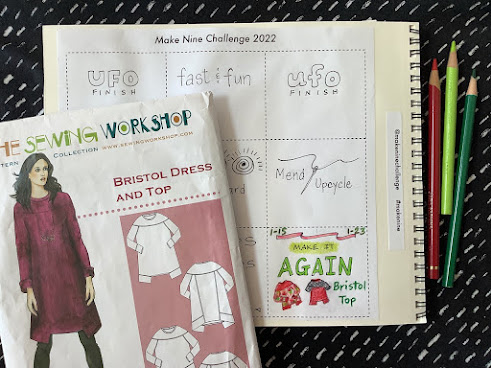
Once you get past the unfamiliarity of a new sewing pattern—modifications, assembly instructions, finishing details—a remake can be a breeze! Looking at my prompts for this year’s Make Nine Challenge, I’m glad I included a new “Make it Again” prompt, because now I’ve got not one, but three Bristol Tops to wear... the last two finished recently in record time. 

The Bristol Top (times 2) is my first Make Nine finish for 2022.

Bristol Top from The Sewing Workshop made with knits from Art Gallery Fabrics.

My wardrobe of Bristol Tops

I made my first Bristol Top [pattern by The Sewing Workshop] in 2020. It was one of the Wild Cards on my Make Nine list that year. The impetus of my Bristol re-make in 2022 was a beautiful floral Art Gallery knit that I spied at a local quilt shop and bought as a holiday gift to myself. (Yes, gift yourself fabric every chance you get!)


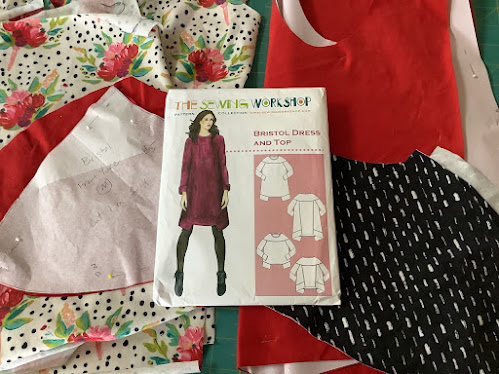
Cutting 2 tops at one time

The Bristol Top pattern has wonderful opportunities for color blocking. My collection of knits from Art Gallery Fabrics is admirable (wink, wink), so I had several options for color blocking this garment.

If you're going to use your lovely Art Gallery knits, you might as well cut out two Bristol tops.

With a solid red knit and a black/white knit print from my collection, I decided on two different color combinations: 

  • the solid red to accent my new floral, and 
  • a black print and solid red pairing. 

Having the fabric decisions made, I cut out pieces for two tops at the same time. Let me tell you... this is the way to go!! It was very efficient!

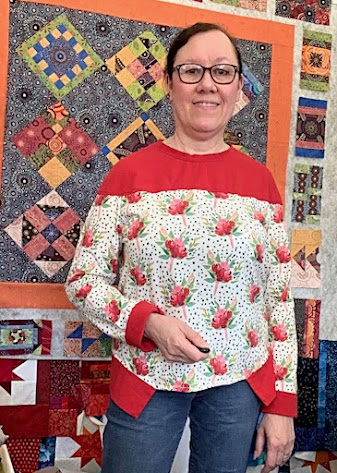
The Bristol Top: long sleeve and color blocked.
Floral knit print is West End Gathers K-54720 from the Bloomsbury collection.

The first Bristol (above) featured the new floral fabric on the bodice. The solid red was used in all the contrasting areas—yoke, cuffs and bands at the bottom.

A pattern hack for version 2

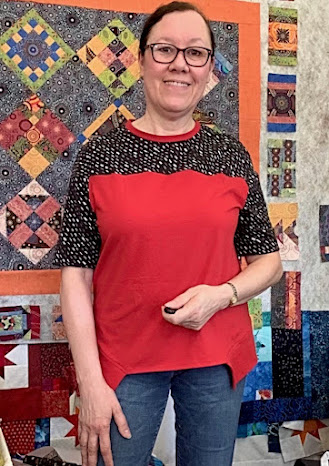
For the second Bristol (below), I tried a pattern hack to make a short sleeve version so I could have a soft cotton knit top for warmer weather. The following weekend, I finished the short sleeve version. This top has fondly become my NIU Huskies [Northern Illinois University] top since red, black and white are the team's colors.

The NIU Huskies top.
A short sleeve version of the Bristol Top.

The Bristol Top is an easy and fun pattern with lots of color blocking options. Or make it from a single fabric print, if you please. And now after this sewing endeavor, I have the pattern piece for the Go Huskies! short sleeve version. 

My first Make Nine finish for 2022 is a multi-success!

The "Make It Again" prompt is the first Make Nine finish for 2022.

You can be sure I'll be on the lookout for more Art Gallery knits in area quilt shops on my travels. And I hope you try a Make it Again project in the near future.


Sunday, March 29, 2020

Social distancing Make Nine finish: the Bristol Top

Are you weathering the COVID-19 storm? As quilters, sewers, knitters and makers, we know the power of stitching and its ability to soothe the soul and ease a worried mind. During this time of social distancing, I have been making charity quilts and checking off items on my Make Nine 2020 list. The Bristol Top is one of my Make Nine finishes.
Me in my new Bristol Top [The Sewing Workshop pattern] made with knits from Art Gallery Fabrics.
I'm standing in front of a work-in-progress, The Farmer's Wife sampler quilt.

The Bristol Top
In a garment sewing workshop I took a few years ago, I saw several people making and wearing the Bristol. It looked great on everyone! I initially passed up this pattern because I didn't see its potential. However, upon seeing how it fit on the body and what others did with color blocking, mini stripes and pattern hacks, I wanted to try it.

Bristol Dress and Top pattern from The Sewing Workshop.

This top makes up so much cuter than its line drawing schematic on the pattern package lead me to believe. This pattern paired with knits from Art Gallery Fabrics is very comfortable to wear.

Contrasting fabric for the yoke.

Pattern details
The fun details for the Bristol—the cuffs, the lower band, front and back yokes and a back panel—are part of its eight pattern pieces. All these have color blocking potential! The construction for the Bristol is straightforward. In fact, the printed instructions are only one side of a single sheet of newsprint.

Cutting out the pattern pieces.

I didn't have quite enough of this yellow knit [from Art Gallery Fabrics] for the entire top, so this situation pushed me to find a coordinating print—which I used for the yoke and neckband.

The sleeve cuffs were an easy, styling detail. They can be worn turned up or down. If you have a directional print, you'll want to pay attention to how the cuffs are attached to the sleeve (if that matters to you).

Cuffs for the Bristol Top.

The diagonal seam lines in the back would make for a slimming effect if the sides and back panels were made with contrasting fabrics. I'm looking forward to trying Bristol with other fabric combinations... and I might try a pattern hack and make it with short sleeves.

Back view of my Bristol Top.

Behind me in the photo above is my Farmer's Wife sampler quilt. It's another WIP [work in  progress] I am working on during this world-wide quarantine.

I hope you have taken up your needles, threads and fabrics to help get through this worrisome time as well. If you need patterns or supplies, contact YLQS [your local quilt shop]! Many shops have on-line shopping, respond to emails and social media requests, offer curb-side pick-up and they still need our support to get through this trying time.

(To my blog stalker: I hope you are well and accomplishing many of your quilting projects.)


Sunday, October 20, 2019

Finishing a cotton embossed 9 Lives top by machine

Next week I'm going to Fall Quilt Market, so my travel schedule is pushing me to finish final details—buttonholes, buttons, hems—on what will be packed in the suitcase. On this plum-colored cotton embossed Nine Lives top, the finishing steps are mostly done by machine.
Nine Lives top from The Sewing Workshop in cotton embossed fabric by Diamond Textiles.

Since the buttons I chose for this top had 4 holes (instead of two), I decided to use the X stitch to attach the buttons by machine. I just have to tie off the thread tails.
Machine sewn buttons and buttonholes.
With my experience making other tops with quilting cottons, I opted to omit interfacing on the front facings. It didn't seem to affect making the machine buttonholes. I'll monitor the success after several wears and washes, to see how it holds up.

Both the sleeve and bottom hems were completed on the machine—quick and easy. The only hand sewing on this top was on the collar seam at the neck on the inside.
Machine hems.

With the cooler weather and change of season, the color of my wardrobe has turned to an autumnal palette. Although this top is made from a lighter weight cotton, this plum colored cotton embossed fabric from Diamond Textiles reminds me of the colors of changing leaves and a fall harvest.

Sunday, June 2, 2019

Reflecting on my Me-Made-May wardrobe

Now that the calendar page has turned from May to June, I'm doing a brief assessment of my participation in the Me Made May Challenge 2019. [#MeMadeMay]
Patchwork jacket with yarn-dyed textured wovens from Diamond Textiles.
Jackets
High on the list of accomplishments in May was making and wearing this patchwork jacket—my new favorite jacket—and also a piece on my MakeNine list. Started in 2018, this one took the longest to complete and, as with most jackets, it had many hand finishing details: button loops, buttons, burying thread tails and hand sewing hems, facings and bias bindings. It also has an inside pocket that was hand sewn into place. But it was worth all the effort! I'm extremely pleased with how it turned out.

This jacket was completed in time to wear in the Diamond Textiles booth at Spring Quilt Market. Yarn-dyed textured wovens are all the rage lately, so it was fun and appropriate to show and wear this jacket. A well-attended schoolhouse session with Linda Lee about using textured wovens for garments, as well as in quilts, reinforced the versatility of these beautiful fabrics.

Knit Tops
I make and wear a lot of cotton knit tops, both long sleeve and short. They are all made from cotton knit fabric from Art Gallery Fabrics. Art Gallery has at least a gazillion different knits—different designs, colors and also solids. You could make a different one for every day of the year!

The fabric is 95% cotton jersey and 5% spandex, so it washes and sews easily while maintaining shape and stability. My knit tops are soft, comfy, easy-care garments that are great for travel. 
Short sleeve knit top. Fabric from Art Gallery Fabrics.
I have several print and solid Art Gallery knit tops that I coordinate with MeMade jackets or wear by themselves. The versatility of layering is great for unpredictable weather and travel.
Short sleeve knit top (front) coordinates with a Primitive Stars jacket.
Here is one of my long sleeve knit tops that I worn with a MeMade knit vest in early May, when the weather was still cool. The Lolita vest is another of my MakeNine projects.
Lolita knit vest paired with a cotton long sleeve knit top.

Woven Tops
I've made 4 Siena Shirts so far and I'm sure there will be more! I know how this top fits and it gets quicker to make each time because I am familiar with the construction. The Siena and Cortona Shirt pattern is from The Sewing Workshop. My shirts are made from 100% cotton woven fabrics and I'm getting my money's worth with this pattern!
Siena Shirt #1. Fabrics from M&S Textiles Australia.

I have worn each of my Siena Shirts a few times throughout May. Pictured here are various versions using several fabrics.

  • Siena Shirt #1 (above): cotton fabrics from M&S Textiles Australia.
  • Siena Shirt #4 (below left) is made with an Australian aboriginal print M&S Textiles Australia paired with a yarn-dyed woven called Tweed Thicket from Diamond Textiles. 
  • Siena Shirt #2 (below right) uses more Australian aboriginal fabrics from M&S Textiles.

Left: Australian aboriginal print from M&S Textiles and Tweed Thicket from Diamond Textiles.
Right: Two complimentary prints from M&S Textiles.

Siena Shirt #3 is made with Stonehenge fabrics from Northcott. More details on the hand stitching embellishments can be found in this blog post.
Siena Shirt #3 made with Stonehenge fabrics from Northcott.

Another Sewing Workshop pattern I like is the Nine Lives Vest. I wore this top at Quilt Market and it's made with a pintuck fabric from Diamond Textiles.
Nine Lives Vest from The Sewing Workshop.
Pintuck fabric from Diamond Textiles.

Other MeMadeMay tops were:

  • Wiksten Top (left): uses Tweed Thicket from Diamond Textiles.
  • Collins Top from In the Folds: uses Nikko Geo 4708 from Diamond Textiles.
I got both of these patterns from TopStitch Studio and Lounge Atlanta.
Wiksten Top (left) made in Tweed Thicket from Diamond Textiles.
Collins Top from In the Folds in Nikko Geo 4708 from Diamond Textiles.

Jackets
This is another well-loved jacket that I made in 2017. I wore it a few times for MeMadeMay and at Quilt Market. Fabrics are from Diamond Textiles.
  • Primitive Stars yarn-dyed woven.
  • Ikat
  • miscellaneous cotton prints for patches on the back.

Primitive Stars jacket.

This jacket is made from the same Raggy Jacket pattern as the patchwork jacket above [Raggy Jacket from Four Corners Designs]. This version has kantha hand stitching on the back. Details about the hand stitching can be found in this blog post.
Kantha stitching and applique patches on jacket back.
See more details in this blog post.

My Me-Made Wardrobe Assessment
You may have heard the latest terminology for the go-to basics you continually reach for from your closet: "core wardrobe" and "uniform" pieces. In reflecting on this month of "Me Made May," I've concluded I'm all about comfort, versatility and functional garments, and my wardrobe and garment sewing endeavors reflect that.
  • The cotton fabrics—knits and wovens—are easy care, breathable and easy to sew/stitch.
  • I re-use my patterns. Once the garment patterns are fitted to my body, style and comfort, the garment construction process gets easier and quicker with each make. There is minimal learning curve with "familiar" patterns.
  • Layering and versatility of individual pieces is important to me. It's imperative for my travel job.
  • Infusing creativity. Even though I use the same pattern multiple times, the choice of fabric, color, threads, embellishments and details will make each garment interesting—to make and to wear.

Did you participate in Me Made May 2019? What did you learn about your wardrobe of your sewing practices? Leave a comment and share what you discovered.

Sunday, March 17, 2019

Visible hand stitching with Stonehenge Solstice

One of the projects on my Make Nine Challenge 2019 list is one that incorporates visible hand stitching. I didn't know specifically what the project would be when I made the list, but trusted that something would cross my work table that lent itself to hand stitching. Here it is. 
Collar detail on Siena Shirt: hand stitching with 5 wt. perle cotton thread.

The Siena Shirt
This is another shirt using my go-to Siena Shirt pattern from The Sewing Workshop. (My third shirt using this pattern.) This time, the fabrics are from Northcott's Solstice collection—a collection of quilting cottons designed to celebrate the 10-year anniversary of Northcott's Stonehenge blender line.
Siena Shirt [The Sewing Workshop] made with fabrics from Northcott Solstice.
The Solstice color palette is a complementary turquoise-blue-green/rusty-orange scheme with celtic motifs on several of the pieces in the line. It's a beautiful fabric collection in Northcott's top-selling color scheme.
Back detail: hand stitches with  8 wt. perle cotton below the yoke.
In addition to the decorative stitches on the collar and at the back pleat, I decided to do the top stitching along the seam lines by hand rather than by machine as prescribed in the pattern instructions.
Hand stitched top stitching along at a seam.
The hand stitched details are done with Eleganza 5 wt and 8 wt perle cotton from WonderFil Specialty Threads.

Today I celebrated St. Patrick's Day with needle and thread. Hand stitching a cotton shirt featuring celtic motifs.     #makeninechallenge #stonehengefabric

Sunday, March 3, 2019

The Odette Top: it's all about the raglan sleeve DARTS!

Generally speaking, I don't much care for raglan sleeve tops—for myself. I have narrow, slopey shoulders, so with a set-in sleeve, there is definition where the shoulder meets the arm, and the silhouette is more tailored. A style I like.

Then I met Odette—a knit top pattern from The Sewing Workshop.
Odette and Ivy Tops pattern from The Sewing Workshop. Note the dart in the raglan sleeve.

I've made the Siena Top (The Sewing Workshop pattern), so I'm 'comfortably' familiar with the sizing, fit and wearing ease of the tops from this pattern company. With a piece of knit fabric from Art Gallery Fabrics [Willow Blooms Spices from the Spices Fusion collection] already pre-washed and longing to be sewn, I decided to give Odette—a top with raglan sleeves—a go.
Odette Top (front).
My Odette Experience
Odette in M (medium) was just as accommodating as my experience with Siena. No mods needed! Yes, believe it! Ms. gorilla arms didn't even have to lengthen the sleeves!
Odette Top (front) showing front peplum.
Making this top could not have been easier. And the best part? The shoulder darts in the sleeves! For someone that doesn't care for raglan style sleeves... the darts made the fit and shaping feel like it was a set-in sleeve.

Edge finishing
One of the things I really like about The Sewing Workshop patterns is that the instructions include when to finish the seams and edges. You don't have to think about it—the pattern tells you when in the process to do this step.
Serged edges in contrasting [red] thread.
My inside detailing for this top is the red thread used to finish the seam allowances and hems. A nice contrast to the black print with the pink floral accents. [And for full disclosure... the red thread was already in the machine.]
Finishing and serging the edges with contrasting thread.
Serged hem finish in contrasting thread.

I <3 this top! The raglan sleeve has other potential design options—like using contrasting fabrics for the sleeves and the bodice. And a short sleeve version would be great for warmer weather.

I highly recommend this pattern. Give it a try. I've changed my mind about raglan sleeves because of the sleeve darts in this pattern! Thank you, Linda Lee and The Sewing Workshop for caring about and adding the details.

Related Posts Plugin for WordPress, Blogger...