Showing posts with label Australian fabric. Show all posts

Sunday, July 25, 2021

I've joined the 100 Days 100 Blocks 2021 quilt-along with M&S Textiles Australia

It snuck up on me this year, but I decided to again participate in the “100 Days 100 Blocks” quilt-along. This is my 4th year. 

It’s gonna be a riot of color and pattern... 
     'cause for 2021, I’m using Australian aboriginal fabrics from M&S Textiles Australia

Blocks from the 100 Days 100 Blocks Quilt-along 2021.


My Fabric Pull

Classified as a “Go bold or go home!” color story, these are several of my fabric picks.

Fabric Pull for 100 Days 100 Blocks 2021. Fabrics from M&S Textiles Australia.


The Kinship Fusion Sampler

This year, the quilt-along coordinator, Angie at @gnomeangel, has offered a few layouts that use subsets of the 100 blocks to make smaller quilts... or possibly multiple quilts. I have a *tentative* goal to make a quilt top with a subset of my 100—even before I've finished piecing all 100 blocks. (Let's see if this works out...). I saw one layout that uses about 20 blocks that I'm considering. 

I'm having fun doing selective cuts [fussy cuts] from the Aborigianl fabric designs this year. I'm also learning a lot by auditioning my fabric pull... considering which fabric will be a background and which will be the focus. Below is a selection of blocks from the first 25.

Block 1 with a focus cut in the center.

Block 15 with a focus cut center.

Block 17 with focus cut wheels in the center 4-patch.

The blocks in this sampler quilt are alternately 8.5" x 8.5" and 8.5" x 4.5" (unfinished sizes).

Block 24 is 4.5" x 8.5" (unfinished).

With this quilt-along, quilters gain proficiency with sewing a 1/4" seam and learn the value of "spinning the seams" to minimize bulk at intersections. My stitch length is set at 2.2.

Spinning the seams in Block 7 (back view).


100 Blocks Quilt-along time table

The 100 Blocks 100 Days quilt-along goes from July 1 through October 8, 2021. Gnome Angel provides a downloadable Event Tracker to keep participants organized. With 25% completion (today, July 25), it's going by fast and looking' good so far. Perhaps with this being my 4th year, I know what to expect and how to manage the process.

If you haven't tried an online quilt-along, consider this one. You can join in any time.

Sunday, April 18, 2021

The Berwick St. Tunic with Australian Aboriginal fabric, a Make Nine finish

My new Berwick St. Tunic by The Sewing Workshop.
Fabric from M&S Textiles Australia.
This is the Berwick St. Tunic in an Australian aboriginal fabric print—my fourth Make Nine finish for 2021.

This Make Nine finish checks the "New to Me" prompt as this is the first time making the Berwick St. Tunic pattern [by The Sewing Workshop]. I also learned a new construction detail: a concealed button placket.

The fabric is an Australian Aboriginal print called Gathering by the Creek (burgundy colorway) by Janet Long Nakamarra [for M&S Textiles Australia]. I loved this colorway the minute I saw it and knew it was destined to be a garment for me.

The warm Spring weather has turned around this week and the Berwick's long sleeves are a comfortable and welcome buffer against the cool temperature. 

Details about the Berwick St. Tunic
This long-sleeved tunic has a mandarin collar, concealed front button placket, pleated front peplum, side vents, and sleeve plackets with narrow,  buttoned cuffs. I have enjoyed working with The Sewing Workshop patterns—the style, the fit, the instructions are all good—and there are always interesting details or construction techniques included in the making of the garments. This one was no different.

The Berwick St. Tunic pattern. The fabric print is one of the Dreamtime designs by an Australian Aboriginal designer. Fabric from M&S Textiles Australia.

The new garment construction detail for me was the concealed front button placket. The pattern instructions were right on point and I sailed through. Hint: if you're not proficient with making button holes, this placket has it covered (literally!). 

In my case, I didn't have enough of the red colored buttons for the front and cuffs, so I used the off-color buttons under the placket and the red buttons at the top and cuffs—where the buttons would show. I opted not to put a button or button hole in the collar as I knew I would wear this garment open at the neck.

Different colored buttons used in the concealed front placket.

I also sewed the sleeves closed with a non-functioning button. The sleeve openings are sufficiently wide to get my hands through. 

Placket sleeves with a narrow cuff.

The irregular stripe of Gathering by the Creek print runs uninterrupted down the single-piece bodice back. No pattern matching was needed! (Gotta love a great stripe!)

The Berwick, back view.

The side vent allows for ample ease. And I have slightly lengthened the sleeves to suit my style... and long arms.

The Berwick's side vent.

Because of the front peplum, you do have to put the tunic on over your head.

The Berwick St. Tunic, front view.

For the next Berwick
Now that I have one make of the Berwick under my belt, the next time I use the pattern I'd incorporate modifications: 
  • give it a full front opening and omit the peplum,
  • shorten to make it shirt length,
  • eliminate the cuff plackets and just use the narrow cuffs,
  • remember the total number of buttons needed.

Me in my new Australian aboriginal Berwick

All in all, it was a successful project and another Make Nine 2021 finish! 

Make Nine 2021 worksheet: April update


Sunday, January 26, 2020

Projects inspired by Aboriginal fabrics

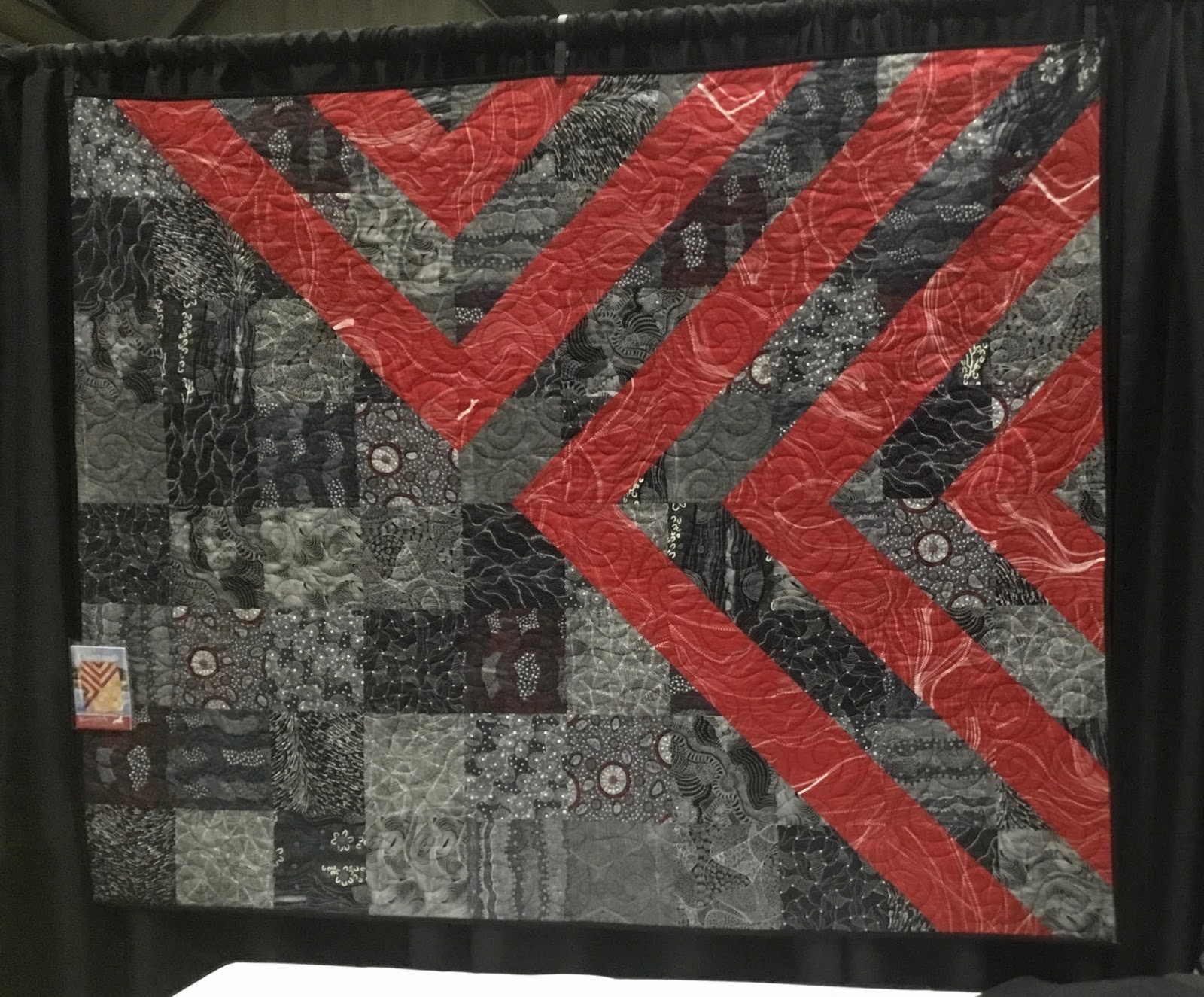
If you need a color "pick-me-up," reach for these contemporary Aboriginal fabric prints from M&S Textiles Australia. The motifs on these cotton fabrics are magical, mystical, and bursting with color. They're one of my favorite quilting fabrics to "make" with.
Fabrics from M&S Textiles Australia.
From left: Yalke Green, Womens Business, Bush Banana, and Gathering by the Creek.
The designs on these fabrics are created by Australian aboriginal artists. They illustrate the symbiotic relationship between man and nature, and tell the story of the Dreamtime.

Inspired by Aboriginal fabric designs
Looking beyond the fabrics themselves, here are ideas for using them in quilts, bags, clothing, and home decor. And they can even inspire free-motion quilting designs and other techniques. Quilt shops and independent sewing centers carry these fabrics and links to a few of these shops are listed with the projects below.

"Cat City" [Villa Rosa pattern] using a variety of fat quarters from M&S Textiles fabrics.

The "6 Pack" quilt featuring Womens Business, Flowers in the Desert green,
Bush Dreamings of Utopia purple (border) and other Australian prints.
 Supplies available at Busy Lady Quilt Shop.

This quilt uses a precut Dreamtime strip roll from M&S Textiles.
The exclusive Star quilt pattern and other supplies available from Sew Many Blessings.
Show off a variety of Aboriginal prints with this "Aboriginal Stained Glass" quilt.
[Melissa and Mom Quilts pattern].

Log Cabin quilt with an on-point setting. Supplies available at Calico Rose quilt shop.

An assortment of black Aboriginal serve as the background to set off Sandhill red.
"Crossroads," fat quarter pattern from Villa Rosa Designs.


Garments
Don't be afraid to use these cotton fabrics for clothing.
The Cottage Shirt [The Sewing Workshop pattern] in Yalke Blue [M&S Textiles].
Details about making the Cottage Shirt in Yalke blue are at this blog post. And see my Sandy Creek Siena Shirt blog post with more photos of the shirt below.
Siena Shirt [The Sewing Workshop] featuring Sandy Creek and Spirit Dreaming.

Siena Shirt [The Sewing Workshop pattern] featuring Women Dreaming burgundy.

Pocket lining or pocket accent with Spirit Place Ecru.

Bags and Totes
Give a bag or tote some attitude with Aboriginal fabrics!
Totably bag [Quilts Illustrated pattern] in Summertime Rainforest black.

Expedition Tote [Swoon patterns] in Yalke Blue and Bambillah.
Made by Debbie at Calico Rose quilt shop.

Expedition Tote [Swoon patterns] in Kingfisher Camp with Sandy Creek accent.
Supplies available at Calico Rose quilt shop.

The Melba Pintuck Bag [The Textile Pantry pattern] with Salt Plain and Sandhill White.
Supplies and pattern available at Kentucky Quilt Company quilt shop.

Summertime Carryall featuring Dreaming in One.

You can take this water koozie with you on the go!
"Walker's Water Bottle Sling" with Bush Medicine 2 blue and Dancing Spirit purple.
Supplies and pattern available at Sisters Side by Side Quilt Shop.

Dreamtime precuts
Precut strips, charms, 10" squares and fat quarters are available in several colorways such as red, yellow, purple, black and assorted. These projects were made with M&S Textiles Dreamtime precuts.
Bag pattern and supplies available at WV Quilt.
The jelly roll race quilt. Dreamtime strip rolls and supplies available at Calico Rose quilt shop.
English paper pieced hexagons from a charm pack or strip roll adorn a pillow.
Class and supplies available at WV Quilt.

A mini tuffet [Tuffet Source].

English Paper Piecing and selective cutting
Try selective positioning and fussy cutting of the Aboriginal motifs for fabulous results.
Fussy cutting and English Paper Piecing with Aboriginal prints.

Detail: from "Oh My Stars" guild Challenge.

Inspiration for free-motion quilting, collage, art quilts
The free-motion quilting on my 2018 guild Challenge was inspired by the fabrics. Details about the process are in this blog post.
Free-motion quilting inspired by Aboriginal fabric designs.

The Winter 2020 issue of Art Quilting Studio features the work of Joan Anderson and her use of Aboriginal fabrics from M&S Textiles in her collaged art quilts.

Article in Art Quilting Studio magazine featuring the work of Joan Anderson
and her use of Aboriginal fabrics from M&S Textiles.

Winter 2020 issue of Art Quilting Studio magazine.

So many possibilities!


Sunday, September 15, 2019

The Cottage Shirt in Yalke blue—30 minutes at a time

These days, it's more and more difficult to find longer, continuous blocks of time to work on our needle arts projects. I was talking with a fellow garment sewer last week about the new Cottage Shirt I was wearing, and she agreed. She mentioned an upcoming quilting retreat she's attending and is eagerly anticipating some dedicated work time for her quilting projects. If you have a sporadic schedule like me—or have too many balls in the air simultaneously (and who doesn't?)—you'd be pleasantly surprised at what can be accomplished in short spurts of time if you keep focused. My new Cottage Shirt is an example.

The Cottage Shirt [by The Sewing Workshop] in Yalke [from M&S Textiles Australia].

For this garment, I've paired another lively, smart-looking Australian aboriginal fabric—Yalke [blue colorway], by M&S Textiles Australia—with the Cottage Shirt pattern from The Sewing Workshop. The Cottage Shirt is a new pattern for me. And even with my involvement in the 100 Days 100 Blocks project, the September Textile Love Challenge, and contributing to an upcoming quilt guild program about using orphan quilt blocks, this top took about 2 weeks to complete—sewing in blocks of time of 30 minutes to about an hour.

The Cottage Shirt in a 100% cotton fabric.

Here is a break down of the process, in manageable chunks.
  • pre-washing the fabrics can be done while doing other things.
  • read through the pattern a few times and familiarize yourself with it. This can be done while you're having morning tea/coffee or at lunchtime, etc. Reading through the pattern also gets you excited about working on the project!
  • Determine your size and trace the pattern pieces. 
Tracing the pattern pieces.
  • I did make a muslin to test the fit. Just a bodice muslin—no collar or sleeve cuffs were attached. I only made one modification to the armhole depth.
  • The pattern layout and cutting was easy. I was careful to match the pattern repeat across the side seams.
Pattern traced and pieces cut.

The sewing process can be accomplished in chunks of time: pre-pressing hems, finishing seams, attaching any interfacings, assembling collar stands and collars, etc. This pattern has minimal pieces (fronts, back, collar and stand, and sleeve cuffs), so there are not many seams or intricate piecing.

Cottage Shirt side vent.

Once I tried on the shirt in the fashion fabric (above), I decided a smaller side vent looked better on me. I just extended the stitching further down the side seam. While modifying the vent, I also decided to make the front/back lengths asymmetrical (photo below). This was an on-the-fly design detail decision. (My shirt, my rules!)

Cottage Shirt side vent modifications: smaller vent and asymmetrical hems.

The bottom hems are stitched down by machine which makes this finishing step quite quick. I hand stitched the sleeve band hems by hand as I enjoy the hand work.

The Cottage Shirt (front view).

Burying thead tails, making machine buttonholes and hand sewing the 5 buttons were the last few finishing steps.

Mid-September sunshine.
I accidentally took this photo, but when I saw it in my iPad photo feed,
I liked how the branches of the tree extended out from where I stood.

Our mid-September weather is surprisingly "in-the-90s hot" and still requires wearing short-sleeve tops. I wore this shirt last week on business calls and received several compliments. The Australian aboriginal prints are always great conversation starters!


Related Posts Plugin for WordPress, Blogger...