Saturday, November 18, 2023

Daylight Saving Time kitty quilts for a friend

When the clocks were turned back an hour for Daylight Saving Time, I took advantage of the “extra hour” for sewing and patchwork. Using improv piecing and a pile of flannel scraps I turned the bonus hour in the studio into a snuggly kitty quilt top for my friend and business associate, Concetta.

Improvisationally pieced flannel kitty quilt.

Concetta (Connie) not only has inside cats as pets, she also feeds and shelters several outside cats. She is a profound animal lover! 

Last weekend, this Daylight Saving quilt top and two other kitty quilt tops were free-motion quilted and the bindings attached.

Free-motion quilting on small flannel quilt.

All these scrappy quilts were improvisationally pieced with various flannel scraps and an upcycled flannel shirt.

Three new scrappy flannel kitty quilts. Sizes: 31.5” x 24”, 31.5” x 24”, 28” x 23”

Each quilt has a flannel backing as well—very soft and warm for the winter weather.

Flannel backings on three new kitty quilts.

Scrappy quilts and scrappy dish cloths

This morning, I packed up the quilts—along with a couple of hand knit dish cloths—and put the box in the mail to Connie. 

Kitty quilts and dish cloths ready for shipping.

The hand knit dish cloths are also scrappy—made with balls and bits of leftover cotton yarns. The stitch pattern is a slip stitch pattern that offers a pretty texture especially with the yarn color changes. Dish cloths are one of my meditative, handwork projects that I take on the road with me on sales trips. We use them in our kitchen all the time. They are useful and colorful.

A care package for Connie and her cats is on its way.


Sunday, November 12, 2023

Earth friendly 100% organic cotton thread hits the quilting and sewing market

There’s a new thread in the market! It’s a 100% organic long staple Pima cotton thread for sewing and quilting by Scanfil. This thread has all the best qualities you want in a sewing and quilting thread and it’s kinder to the earth, as well. 
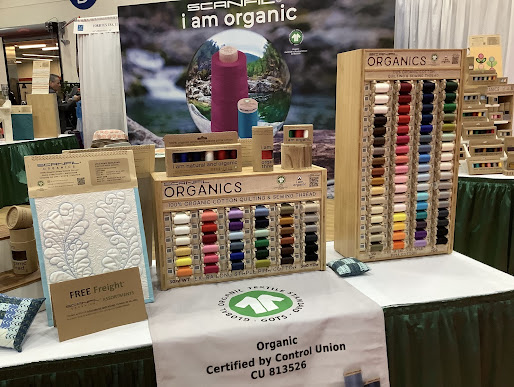
Scanfil 100% organic cotton threads at the 2023 Quilt Market.

What’s “organic” thread?

I was introduced to this organic thread product by one of my fabric rep associates, Andy Jacobs. Scanfil was looking for new sales representatives in the US so he put me—and a few other sales reps—in contact with the company. Thread is a good complement to the quilting fabrics I rep, and I trusted Andy's recommendation. 
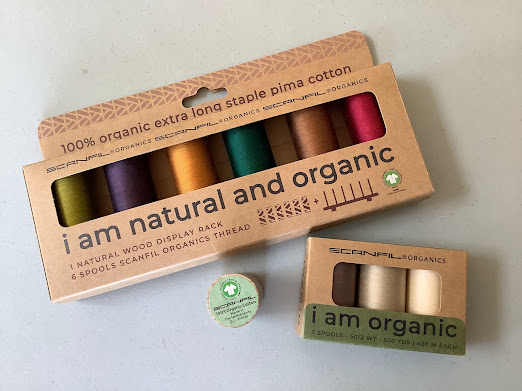
Six- and three-spool thread sets from Scanfil Organics.

The manufacturing and thread specs, and the benefits of this organic cotton thread are:

  • extra long staple organic Pima cotton thread. Pima cotton is responsibly grown in the USA.
  • GOTS [Global Organic Textile Standard] certified to ensure ethical and sustainable production; free of pesticides and toxic chemicals.
  • OEKO-TEX certified—tested for substances that could be harmful to human health.
  • Forbitex, the parent company of Scanfil, is a second-generation family-owned business in the Netherlands. The company's threads are all manufactured in Europe.
  • a unique spinning process provides strength to the thread.
  • dyed and coated with natural solutions that are free of impurities.
  • mercerized for smoothness, more receptive to colorants, and yields virtually no lint.
  • precision wound with no knots on biodegradable wooden spool cores (no plastic).
  • thread will not shrink or bleed with washing.
  • packaged in recyclable, biodegradable kraft paper products (no plastics are used).
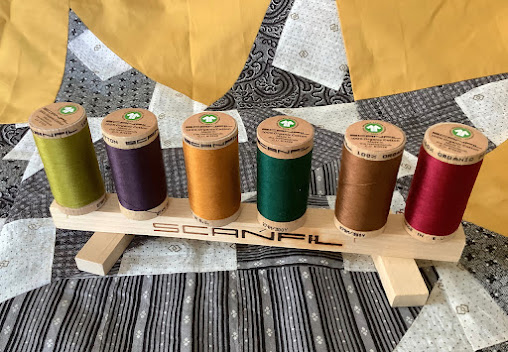
A bamboo thread stand comes with the 6-spool thread sets.
  • currently available in 2-ply 50 wt and 2-ply 30 wt solid colors.
  • individual spools, cones, and curated thread sets in both weights are available.
  • a bamboo thread stand is included with each 6-color thread set.
  • the smoothness of this thread will feel better to the skin. Those with allergies or chemical sensitivities may find relief from using certified organic thread or items sewn with it.
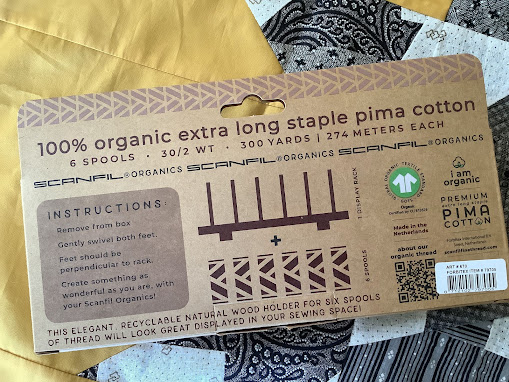
The packaging of the six spool thread set.

Let’s “Kick the tires”

Before discussing this product with my client base, I wanted experience using it. I put the thread through the paces—piecing patchwork, free-motion machine quilting, and hand stitching. My new zipper tote is proof of the testing.

Zipped tote bag pieced and quilted with Scanfil 100% organic cotton threads.

Piecing and patchwork

I loaded the 50/2 wt. thread in both the top and the bobbin for testing patchwork construction and piecing. The blocks shown below are pieced improvisationally. 

Findings:

  • bobbins were easy to wind and I was able to get a lot of yardage on the bobbin using the 2-ply 50 wt. 
  • There were no issues threading the machine or with machine piecing. I used the 50/2 wt for piecing with an 80/12 universal needle. 
  • after piecing the outside of the tote, the bobbin area was fairly lint free.
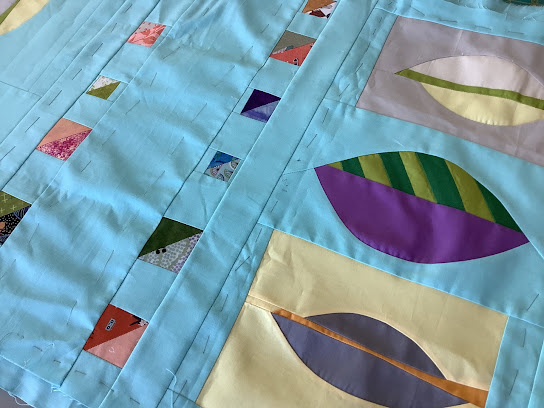
Patchwork blocks and bag construction. Layers were hand basted for doing hand stitching.

Hand stitching/Hand quilting

After patchwork and construction of the bag's outside, the quilt layers (patchwork top, a 100% cotton quilt batting, and a quilting cotton for the bag lining) were hand basted. I used several colors of the 30 wt. threads to do a bit of hand stitching/quilting. 

Findings:

  • The 30/2 wt gives more prominence to the stitches.
  • The thread glided easily through a hand sewing needle and through the fabrics. The majority of the fabrics are Painter's Palette solids from Paintbrush Studio.

Hand stitching using 30/2 wt organic thead.

Machine quilting

The 50/2 wt organic cotton was used in the top and bobbin for the background fillers. The 30/2 wt was used in the top for the decorative quilting details on the block motifs. The machine needle used was a 11/75 quilting needle.
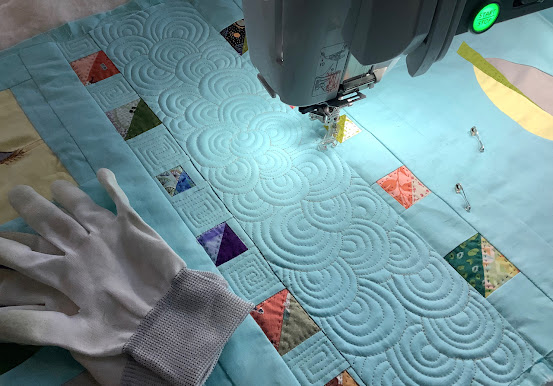
Free-motion quilting starting at the bag bottom.

Findings:

  • For the free-motion quilting (on a domestic machine), I used the 50/2 wt. for the background fills—spirals and bubbles.
  • Thread tension was easy to balance. No thread breakage or shedding through the needle occurred. I used nearly two bobbins to quilt this piece.
  • Back-tracking had minimal build-up using the 50/2 wt thread.
  • Minimal lint in the bobbin area of my machine after 3 - 4 hours of machine quilting.
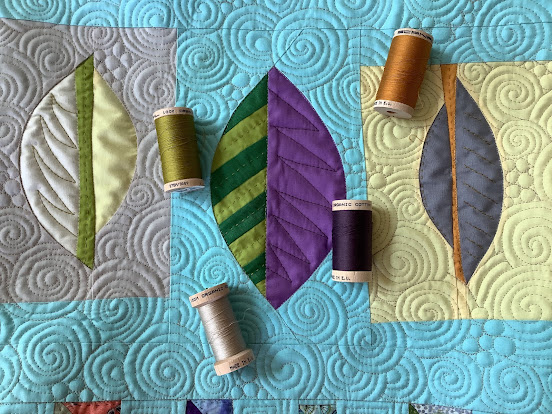
The 30/2 wt thread was matched to the patchwork motifs. The 50/2 wt thread was used for the free-motion quilting.

Decorative machine stitching

I put a green 30/2 wt thread in the top thread and used a decorative 3-step zigzag stitch on the bag handles. 50/2 wt was used in the bobbin. 

Findings:

  • No issues or skipped stitches using the 80/12 universal sewing machine needle.
  • Although I used the built-in decorative stitch on just the bag's handles, I feel confident this thread would do a beautiful job with other decorative machine stitches. As with any thread, I do a sample swatch to determine what stitches, stitch width and length, and thread weight give the desired effect.
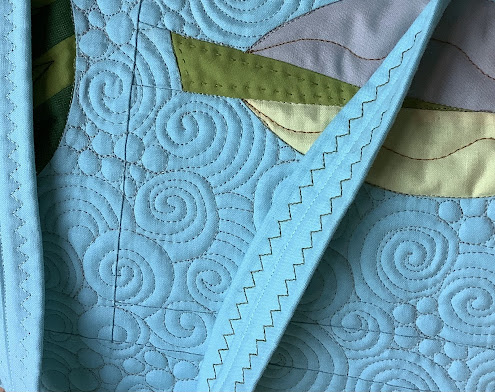
A decorative stitch was used on the bag handle with the 30/2 wt thread.

Machine friendly threads

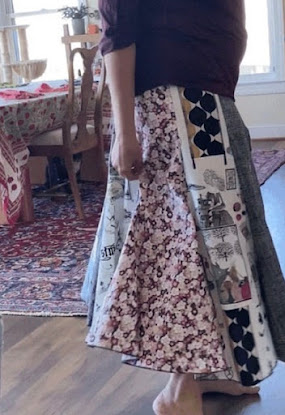
Serged skirt using Scanfil organic cotton thread.
Fabrics from The Ghastlies collection from Alexander Henry.
Photo credit: S. Zimmerman
The Scanfil organic thread line is rated to perform well in other sewing machines such as sergers and longarm quilting machines. 

One of the new Scanfil reps used the cones on her serger to sew a gored skirt. She informed us that the thread worked like a champ. She noted her well-loved and well-used serger had “very little lint in the mechanism… demonstrably less than [another well-known brand of thread].” I suspect the mercerization and gassing processes performed during the manufacturing of the Scanfil thread greatly contributes to its success. 

Customer testimonial

This past August, I left a sample spool of the Scanfil thread with one of my shop owners. The shop owner, in turn, gave it to one of her regular customers to run it through the paces. Determined—at first—that she would not like the thread, the customer gave it a go anyway. 

I'm happy to report that @combat_quilter was pleasantly surprised with the Scanfil thread's performance. (Thanks for keeping an open mind, Terri!)

More thread uses and techniques 

In addition to the sewing and quilting techniques discussed here, there are other uses for this organic thread: hand or machine appliqué, decorative stitching, heirloom sewing, home decor, thread painting, to name a few.
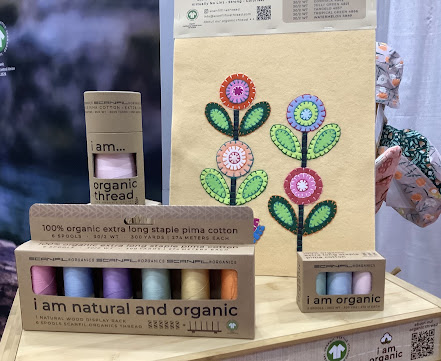
Scanfil organic thread sets and appliqué example.

Need thread? Choose organic!

The next time you reach for thread, why not go earth-friendly with organic? With Scanfil Organic, you won't be giving up any of the characteristics of a fine, reliable thread that you've come to know and trust.

Visit your local quilt shop and ask for Scanfil organic threads. Independent quilt shops and sewing centers are beginning to carry the full collection of colors as well as the thread sets. Treat yourself—and a quilting friend—to a spool (or three) of Scanfil organic thread.
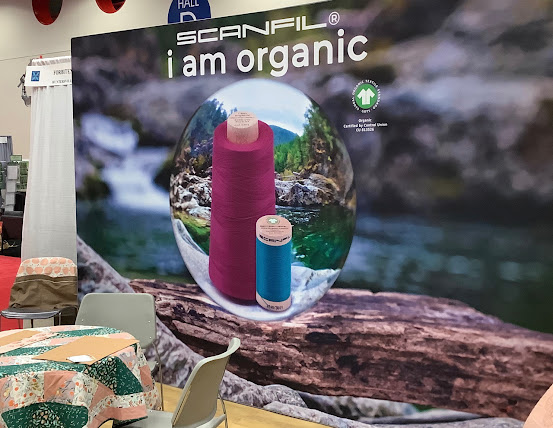
Try Scanfil 100% organic Pima cotton thread on your next sewing or quilting project.


Sunday, November 5, 2023

Final Make Nine 2023 project: jacket and pants

I’m counting this ensemble—a jacket and pants—as my final Make Nine project for 2023! I’ve had the pants pattern pieces cut out for quite a while, and the other fabrics were in the stash. Both were waiting for inspiration and motivation to strike… not to mention finding time to sew. 

Cotton/linen jacket, Make Nine 2023

Event deadline = Motivation

With my plans to attend the International Quilt Market, I had the motivation needed to get on with the sewing. It always feels a bit special to wear something “new” to a business event, so this was the perfect impetus for a sewing episode.


Patterns and materials

The pants pattern is a frequently used one for me—the Valencia pants [from The Sewing Workshop]. The Raggy Jacket is my go-to pattern for a jacket. I’ve made several jackets over the years with this pattern. The pattern pieces are sized and I’m familiar with the construction.

The Valencia Pants and Raggy Jacket patterns: both frequently used for my garment makes.

Pants and Jacket materials:

  • the pants fabric is a yarn-dyed woven [Diamond Textiles]. The pants were already cut out, complete with tailor tacks! 
  • the outer fabric for the jacket is a cotton/linen blend [FIGO Fabrics]
  • the lining is a cotton voile [Art Gallery Fabrics]
  • middle layer of the jacket was a light colored cotton quilting fabric
  • the decorative quilting thread is a variegated 40 wt cotton thread [YLI]

Garment construction

The Valencia pants are a one-seam pants with a partial elastic wasteband. My hack for this pattern is the addition of two patch pockets. Since the pieces were already cut out and marked, this was a relatively quick finish.

The Valencia one-seam pants.

The jacket required more time. After laying out and cutting all the jacket pieces, quilting guidelines were marked with a Chaco Liner. I “quilt” the individual jacket pieces—fronts, back, sleeves—with the fashion fabric, a cotton or muslin middle layer, and the lining.

Marking stitching guidelines with a white Chaco liner.

The quilting stitch pattern is a combination of a straight stitch and a built-in decorative stitch on my machine. It looks a bit like barbed wire, but it complemented the graphic, wood cut design on the fabric.

Decorative stitch pattern for quilting the jacket pieces.

One of the finishing tasks for the jacket is deciding on the buttons. This is always an extensive auditioning process. (I admit I have a “healthy” button collection.)

Choosing buttons. Always, so many options!

Matching the fabric motifs

The print of this fabric made for a challenging layout process—making sure the motifs lined up. It was not the best choice of fabrics for the time constraints and deadline, but I was curious about sewing with a linen fabric and in the end, it turned out fine. I learned a lot about pattern layout and lining up motifs from making my kalamkari jacket, using the same jacket pattern.

My new cotton/linen jacket. A Make Nine 2023 finish.

Make Nine 2023 is complete!

This concludes my Make Nine Challenge for this year. My new jacket and pants are fulfilling the “UFO” prompt. It’s been a productive year.

Fulfilling the “UFO” prompt for Make Nine 2023.

Completed Make Nine 2023 tracker.


Sunday, October 22, 2023

Needlework buttons: historical techniques using contemporary materials

The internet diminishes the distance between needleworkers for sharing ideas and techniques. From my kitchen table, I joined a group of UK stitchers and embroiderers this weekend for a Zoom workshop on making needlework covered buttons.

Needlework covered buttons from a recent workshop with Gina Barrett.

The two-hour workshop, called “Curiously Wrought: Making Needlework Buttons with Gina Barrett,” was sponsored by the Embroiderers’ Guild in the UK. Gina Barrett, the workshop’s instructor, is an author, illustrator, entrepreneur, and maker. She brings her passion for period costumes and historical passementerie to her workshops and her extensive experience in the craft is evident in her ease and skill of presenting and teaching these historical button-making techniques.  

Stitching commonalities 

Although there is a distinction between “embroidered” buttons and “needlework” buttons, Gina explained, if you are an embroiderer or hand stitcher, you’ll find many that of the stitches used in making needlework buttons seem familiar. Several workshop participants sited using the stitches in other textile disciplines—although were called by a slightly different name. In this workshop, we used the basic the rounded back stitch, blanket stitch, and a spiderweb stitch for our class buttons.

Supplies for making needlework covered buttons.

Button-making supplies are probably already in your stash

The supplies needed for this technique are minimal and comprised of items that most needleworkers and stitchers have on hand—perle cotton thread, small fabric scraps, buttons, needles and scissors. Workshop participants learned three button designs. Compared with historical buttons that were made in the 16th, 17th and 18th centuries, today’s needleworkers have myriad threads, fibers, colors, and thread weights available in the market to provide endless possibilities for creativity and developing unique designs. Gina was very encouraging and supportive of experimenting with any of them. 

Finding your rhythm

As one would expect with any new skill, continued practice will provide more consistent results. Gina indicated that once you find a good stitching rhythm, balanced thread tension usually follows—providing more desired results. 

This workshop was a wonderful experience and the buttons were fun to make! My first attempts need more finessing (obviously—by the photos), but now that I have a general understanding of the basics for making needlework covered buttons, I’ll be applying more effort and practice into achieving finer results.

I’m adding needlework buttons—another small, portable project—to my travel bag repertoire.


Related Posts Plugin for WordPress, Blogger...