Showing posts with label Cuddle Quilts. Show all posts

Sunday, April 19, 2026

Progress made in threes on charity projects

There’s been a lot of progress both on and under my needles lately. Under the needle—or more accurately, under the presser foot—I’ve finished the three cuddle quilts that were sandwiched at the guild workshop a few weeks ago. 

Three completed charity quilts.

The first quilt (above left) uses a fabric panel. Using fabric panels is a great shortcut when you want a quick, but polished result. The panel—a scene of colorful dinosaurs, trees, mountains and a volcano—needed no extra patchwork. The quilting design was a modified concentric circle motif and the quilt came together in no time.

Circle quilting motif on the dinosaur panel quilt.

The second [triangles] quilt is from a pre-cut quilt kit. The patchwork runs from edge to edge and there are no borders for more contemporary style. The triangles showcase the various colors and patterns of the fabrics. The large, free-motion spirals contrast with the geometric design of the patchwork.  

Swirls quilting motif on triangle quilt.

The third quilt was made from discontinued fabric samples and scraps. Being that the prints were mostly florals, the free-motion quilting has flower, leaf, and vine motifs. 

Free-motion quilting flower, leaf, and vine motifs.

Binding by machine

The bindings for these quilts were attached by machine for a clean, durable edge… and a fast finish.

Bindings attached by machine.

At the workshop, the quilt tops were measured and lengths of pre-made binding were cut. The lengths were right on the money! The remaining pieces will find their way into future scrappy bindings. 

Very little binding remained after the quilts were bound.

Quilt stats:

  • Dinosaur quilt: 34.5” x 41.5” (finished size); 1.5 hrs free-motion quilting.
  • Triangles quilt: 34.5” x 41” (finished size); 1.5 hrs free-motion quilting.
  • Floral patchwork quilt: 41.25” x 45.5” (finished size); 2.25 hrs free-motion quilting.
  • Binding for all three quilts: 3.75 hrs.

The backs of the cuddle quilts are colorful, too.

Backing fabrics for these cuddle quilts.

Mitten Knitting

On the knitting front, three more pairs of mittens came off the needles. I continue to try new patterns to use up orphan balls of yarn and fill small pockets of time. 

Three more pair of knitted mittens off the needles.

It’s good to see these charity projects move to the finish line. Each one feels like a small, cozy accomplishment.

New mittens in progress. This is the “Elf Fit Mitten” pattern.


Saturday, August 23, 2025

Scrappy charity quilts and free-motion fun

There’s something satisfying about turning a pile of leftover fabrics into something cozy and full of heart. Easy patchwork, fun sewing, and a bit of therapy at the sewing machine—it doesn’t get much better than that. 

Kitty quilt with improv patchwork and free-motion quilting.

I brought two “kitty quilt” [charity quilt] tops to my Intro to Free-motion Quilting workshop at the Folk School earlier this month. I used them to demonstrate basting and the Kwik Klip tool

Demonstrating basting with the Kwik Klip tool on a charity quilt.

Students also got a chuckle over the “franken-batting” I made by zig-zagging leftover batting scraps together.

Pieced batting using up batting scraps: “Franken-batting.”

Using up scraps, the patchwork for these quilt tops (as well as the batting) is simple and improvisational. These tops are the perfect canvases for some easygoing, free-motion quilting. One top was used in class to demonstrate free-motion zig-zags. 

Two completed charity quilts for the Cat Clinic.

The quilts are finished with scrappy bindings that are attached with a machine zigzag and a variegated thread. 

Scrappy bindings applied all by machine.

Bonus: the flannel trimmings from the quilt backings were pieced together for the back of a future kitty quilt! Hooray for more scrappy improvisational patchwork!

Making do: fabric trimmings were used to piece another quilt back for a future quilt.

In addition to quilting the kitty quilts, I also pieced a cuddle quilt top for my guild’s charity. 

Charity quilt top ready for basting and quilting.

Scrap quilting is always a joyful process for me. It’s a great reminder that even small, forgotten pieces can come together to make something beautiful and meaningful.

Can you envision a scrap-buster quilt in your future? I hope so.


Sunday, April 13, 2025

Gettin’ into the FMQ groove at the cuddle quilt workshop

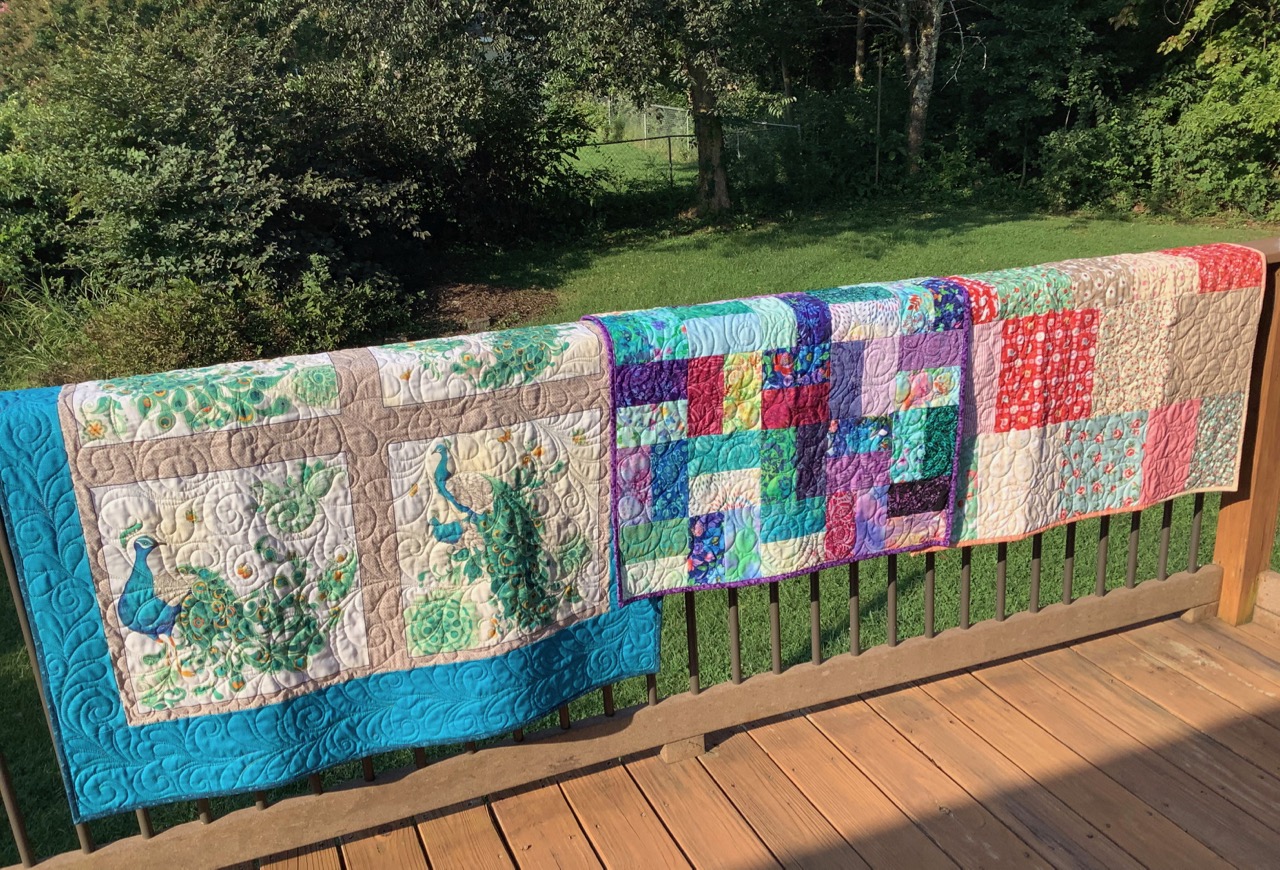
I had a fun afternoon visiting with the Choo Choo Quilters at their Cuddle Quilt workshop this weekend! With three finished cuddle quilts to turn in, I popped in at the workshop and got four new quilt tops spray basted.

Three cuddle quilts finished.

Quilting designs: finished cuddle quilts

One of the finished quilts was made with this peacock panel. The free-motion quilting pattern was feather variations, with a thread change for the border.

Feathers quilted on the peacock panel quilt.

The second quilt had flowers and loops quilted into it. This design quilts up fast. 

Flower quilting design.

And the third was quilted with swirls and circles.

Swirls and circles quilting on this mix of batiks and cotton prints.

I try to keep the width of cuddle quilts to less than about 42” wide so the backing fits on a standard 44/45” fabric width. The finished sizes of the three cuddle quilts that were turned in:

  • (left): 29.5” x 35.5”,
  • peacocks (center): 41.5” x 46” 
  • tiny florals (right): 34.5” x 36.5”.

The cuddle quilts for the guild’s community service project.

Quilting the new quilt tops

At the workshop, I reconnected with guild members I hadn’t seen in a while and I met some of the new members. It was a lovely visit! The weather was cooperative for outside spray basting and the four tops I brought got basted.

Four spray basted quilt sandwiches.

I was so inspired from the workshop, I sat down at the sewing machine and quilted two of the basted tops immediately.

Two cuddle quilts quilted in an afternoon.

A swirls and feathers quilting motif for this one.

Swirls and feathers. FMQ: 45 minutes.

Double circles for this one.

Double circles. FMQ: 1 hour.

After dinner, the third one—with several small floral prints—was quilted with flower motifs.

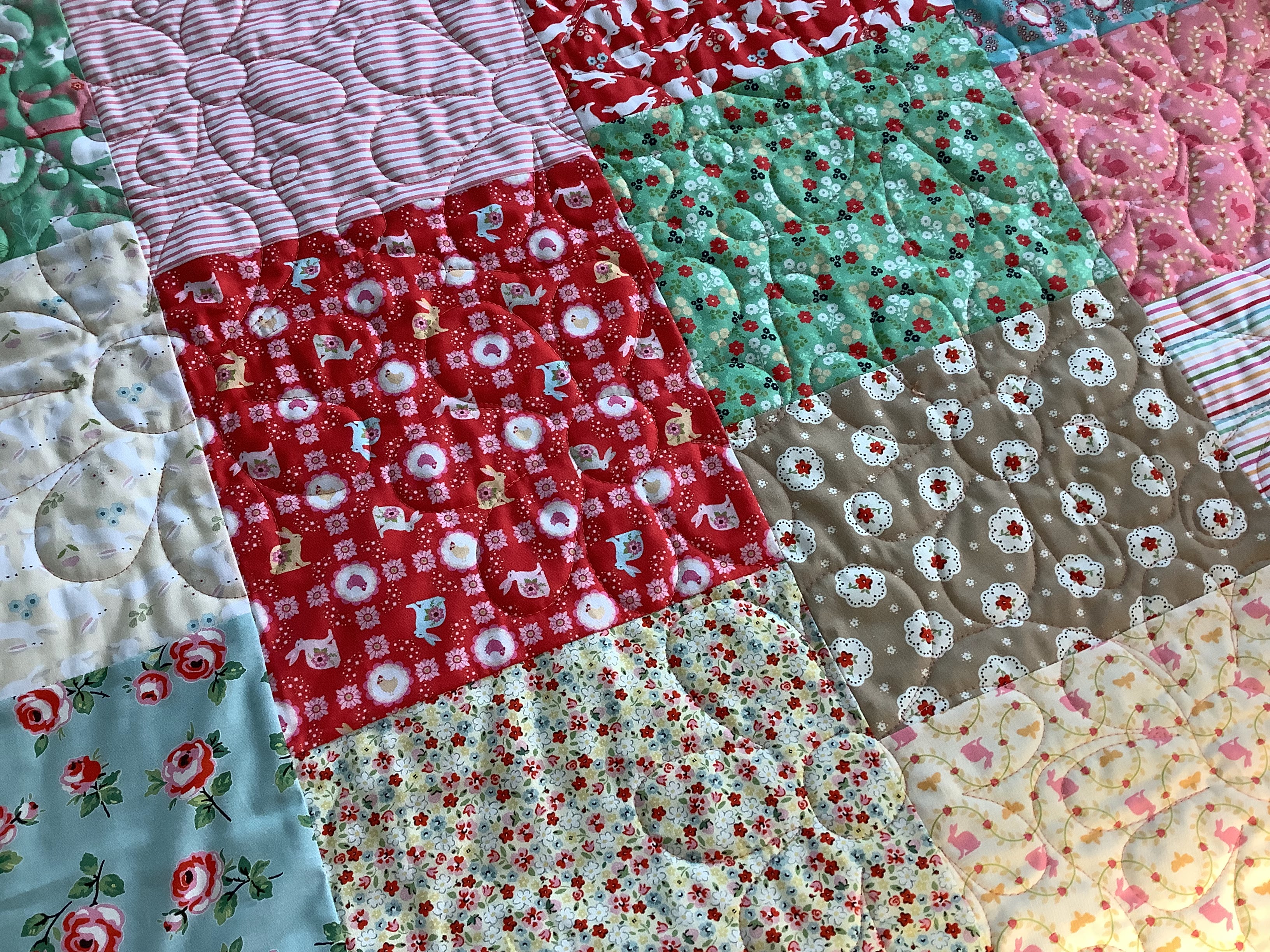
Small floral prints mixed with stripes and blenders.
Flower motifs quilted on the quilt. FMQ: 30 minutes.

The last cuddle quilt top is from the Make Do wreath blocks that I pieced back in December. I haven’t decided on a quilting motif yet… and all-over pattern? or msybe something that follows the patchwork?

Wreath block quilt top.

I’ve got bindings picked out for these quilts. And from the leftover backing fabrics, I cut several binding strips to add to my binding inventory.

Binding strips from backing fabric after trimming to size.


Tuesday, August 29, 2023

Make Nine finish #8: fast and fun cuddle quilts

In a recent post, I published tips and ideas for making quilts using time-saving techniques, fabrics, and tools. These ideas were used for three charity quilts that were completed for my guild's community service project. I'm using this "finish" to fulfil my Make Nine "Fast and Fun" prompt this year. 

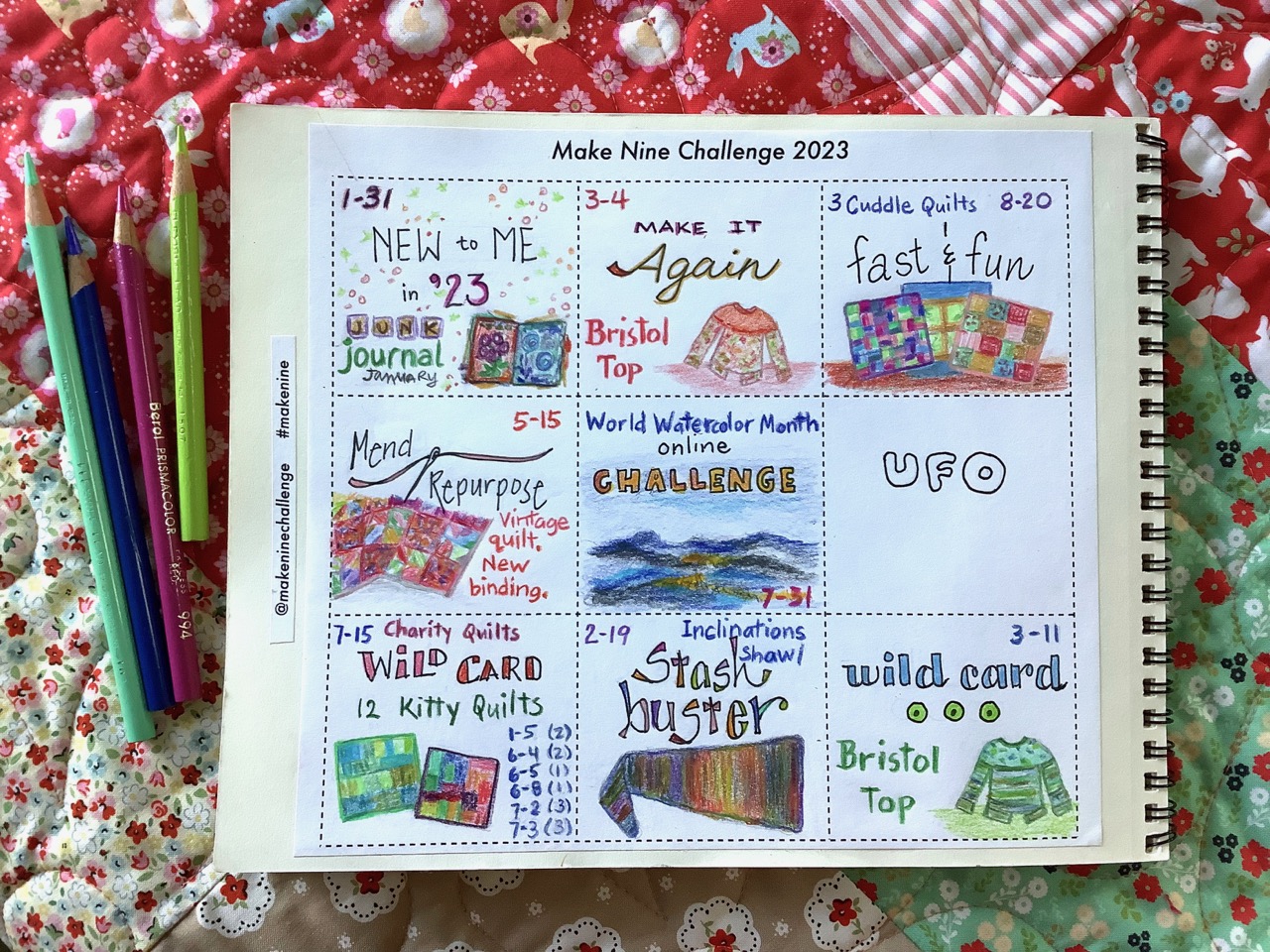
"Fast and Fun" prompt for Make Nine 2023 is fulfilled.

Initially, I thought my "Fast and Fun" prompt might be fulfilled with a set of pillowcases—also a fun project—which I usually make for gifts throughout the year. It just goes to show that one never knows what projects will be put in one's path... these quilts crossed my path first.

Here are the three completed cuddle quilts (charity quilts) for my guild's community service project. With some planning and time-saving construction ideas, they were fast and fun!

Three finished charity quilts.

Now I'm feeling ahead of the game with Make Nine this year—with only one prompt remaining. The last prompt is a UFO finish

Oh, I have plenty of options for this one!

Make Nine 2023 tracker, August 2023.


Saturday, August 26, 2023

Expedite your quiltmaking tasks with quick methods, tools, and "convenience fabrics"

Three cuddle quilts completed in a week's time! Although these are smaller size quilts, the following tips can be applied to any quilt that you want to finish more quickly. 

Three finished cuddle quilts for charity.
Finished sizes (from left): 41.5" x 46", 29.5" x 35", 34.5" x 36.5"

Making the Quilt Tops

I used three different patchwork methods to create the tops for these quilts. 

  • Big fabric patches of varying size
  • A two-fabric block
  • A fabric panel with added borders

Basted Cuddle Quilts. A two-patch block design (left) and a big patch design (right).

The Big Patch design

The quilt top on the right is the easiest and quickest to assemble.

  • Pull a variety of fabric prints (these happened to all be from the same fabric collection).
  • The blocks/patches are the same height but varying width. Mine were 9.5" in height by anywhere from 5.5" to 10" wide.
  • Arrange the blocks/patches so the corners DO NOT meet.

Sew the blocks into rows. Then, when sewing the rows together, you won't have to worry about matching corners and nesting seam allowances because the patches are of different widths. It's an easy sew.

Two-patch blocks using various fabric prints and batiks.

Two-patch block design

The quilt top above is fun and scrappy. It started with a handful of rectangles that were about the same size—around 6.5"-7" by (about) 3".

  • Pair the rectangles and chain piece them (on the long side) into 2-patch units. Do this in one sitting, or keep a stack of rectangles near your sewing machine and use them as "leaders" and "enders" while sewing other projects. (I did a little of both.)
  • Pick the smallest pieced block and trim this one to make it square. Trim all the others to that size. Mine ended up at 6.5" square.
  • Arrange blocks in a "rail fence" layout. Sew the blocks into rows and then sew the rows together.
Spinning the seams in the two-patch quilt top.

Tip
: If the seam allowances of each row are pressed in an alternating fashion (toward the unpieced unit), the seam allowances will nest at the intersections when sewing the rows together. Spinning the seam allowances at the block intersections will minimize bulk, allow the top to lie flatter, and avoid any big lumps that would interfere with your machine quilting.

Cuddle Quilt using a fabric panel. 41.5" x 46"

Fabric panels—the "convenience fabric"

The peacock quilt was made using a fabric panel. How much easier can it get? It's like a microwave meal or a TV dinner... no fuss, no muss. Just add borders (or not!) and it's finished!

  • I added a 4" border to the sides and a 6" border to the top and bottom. The borders made a nice frame aound the 4 "faux" quilt blocks.
  • The border measurements were intentional. They kept the top within a 44/45" width to accomodate a single piece of fabric for the backing (no piecing the backing fabric—another time-saver).
  • The larger top and bottom borders made the quilt rectangular (rather than square).

Spray basting the quilts

As mentioned in this post, spray basting is a fast way to get the quilt sandwich ready for quilting. If you have a quilting buddy to help you, it's even faster!

  • Read the instructions on the can of spray baste. It tells how much, how far, etc.

  • Account for any overspray: cover the floor around the area, lay down an old sheet beneath the quilt back, or cover/protect the table with newspaper.

  • Spray baste in a well-ventilated space.

Quilting the quilts: Free-form and free-motion

Cuddle quilts and charity quilts are great for experimenting and practicing your free-motion quilting. The recipients of your endeavors will love the quilt and appreciate your kindness regardless of your skill level. And how do you get better at FMQ? With practice!

Load several bobbins before you start quilting.

Here are time-saving tips for machine quilting:

  • I used the same backing fabric for all three quilts. Choose a matching thread and load several bobbins before starting. If your backing fabrics are different, you could use a neutral/blending thread in the bobbin for all.

  • Load one extra bobbin for adding the binding by machine.

  • I don't mark the tops. Just drop the feed dogs, hit the pedal, and quilt intuitively!
  • Start quilting somewhere in the middle (on a "busy" fabric) and meander around, moving toward the edges of the quilt sandwich.

Large flowers were free-motion quilted on this Cuddle Quilt.

  • Be inspired by the fabrics to come up with a quilting design. The big-patch quilt (above) was free-motion quilted with large flower motifs. The feather-and-swirl design was inspired by the peacock tails (below).

Cuddle quilt made with a fabric panel.
Free-motion feather motifs mimic the peacock plumes.

  • Quilt with a larger motifs to cover the top in less time.

  • Combine one or more motifs such as the swirls and circles (below). Sometimes you need a different motif to fill weird spaces, to change the direction of your quilting path, or just make the quilting more interesting—for you (the quilter), and for the viewer.

Free-motion quilting with large swirls and circles.

Machine binding

Hands down, machine binding is much quicker than hand binding. 

  • I periodically cut 2.5" strips of left-over or stash fabrics to make bindings. Sometimes they are from a single print, sometimes they are scrappy bindings.
  • I use a piece of double-sided, water soluble sticky tape (made for sewing and quilting) to keep the miters in place when machine stitching the top. Or use a basting glue (like Roxanne's Glue Baste It).
  • You could use the water soluble tape or basting glue to secure the entire binding to make the sewing go quickly.

Machine binding on Cuddle Quilts.

Adding a special detail

Just because a quilt is made with time-savings techniques and tools, doesn't mean you can't add a personal detail to make it special. Here are some ideas:

  • A scrappy binding can be a fun detail and echo the variety of colors that are in the patchwork.

Switch out the top thread with a variegated thread to add a special detail to the free-motion quilting.

  • I used a variegated thread on the turquoise border on the peacock quilt. It doesn't show well in this photo, but the sparkles of the reds and oranges in this variegated thread add a surprising detail.

Here are additional photos of the quilting and the finished cuddle quilts.

Border and corner free-motion quilting.

Feathers and swirls on the peacock panel quilt.

Free-motion machine quilting (back view).

Finish quilt sizes:

  • Peacock panel quilt: 41.5" x 46"
  • Two-fabric block quilt: 29.5" x 35"
  • Big patch quilt: 34.5" x 36.5"

Three completed cuddle quilts.


Sunday, August 13, 2023

Spray basting and free-motion quilting small charity quilts

One of the fun and fulfilling aspects of quilting is creating small charity quilts as a way to show kindness and bring smiles to others. This weekend, my guild held its annual Cuddle Quilt workshop and I brought three pieced quilt tops to the workshop to take part in the “group spray-basting session” to prepare the tops for free-motion quilting.

Load the bobbins. Get out the quilting gloves. Get ready for free-motion quilting charity quilts.

Making small charity quilts

The cuddle quilts the guild makes are for children. They are small, lap size, or the size for a child to nap on. For these quilt tops, we aim for a quilt size that is no more than 42” - 43” wide. This size accommodates a backing fabric can be cut from a bolt of 44"/45" fabric without having to piece it.

These smaller quilts also expedite the basting, quilting and binding processes and we're able to make many and finish them quickly. Even beginner quilters can join in and achieve success.

Easy patchwork quilt top and big flower free-motion quilting motif.

Quilting design ideas for small charity quilts

I free-motion quilt on a domestic sewing machine so the smaller size quilts are easy to maneuver in the throat space of a home sewing machine. I like to experiment with different free-motion quilting designs on these charity quilts. Simple shapes—loops, swirls, flowers, leaves, hearts—are good motifs for for charity quilts and are beginner-friendly as well.

Swirls and circles are free-motion quilted on this charity quilt.

I use one motif or a combination of 2 or 3 motifs to create a meandering, all-over design. Beginner quilters can practice drawing the motifs in a sketchbook before putting needle and thread to the quilt sandwich. The more adventurous quilters can just drop the feed dogs and free-motion intuitively. 

A continuous line, meandering motif will interlock organically across the quilt top and add a wonderful texture to the quilt. 

Two quilted charity quilts ready or trimming.

I quilted two of my cuddle quilts yesterday. Scrappy bindings will be added after trimming and squaring. They'll be finished in no time.


Related Posts Plugin for WordPress, Blogger...